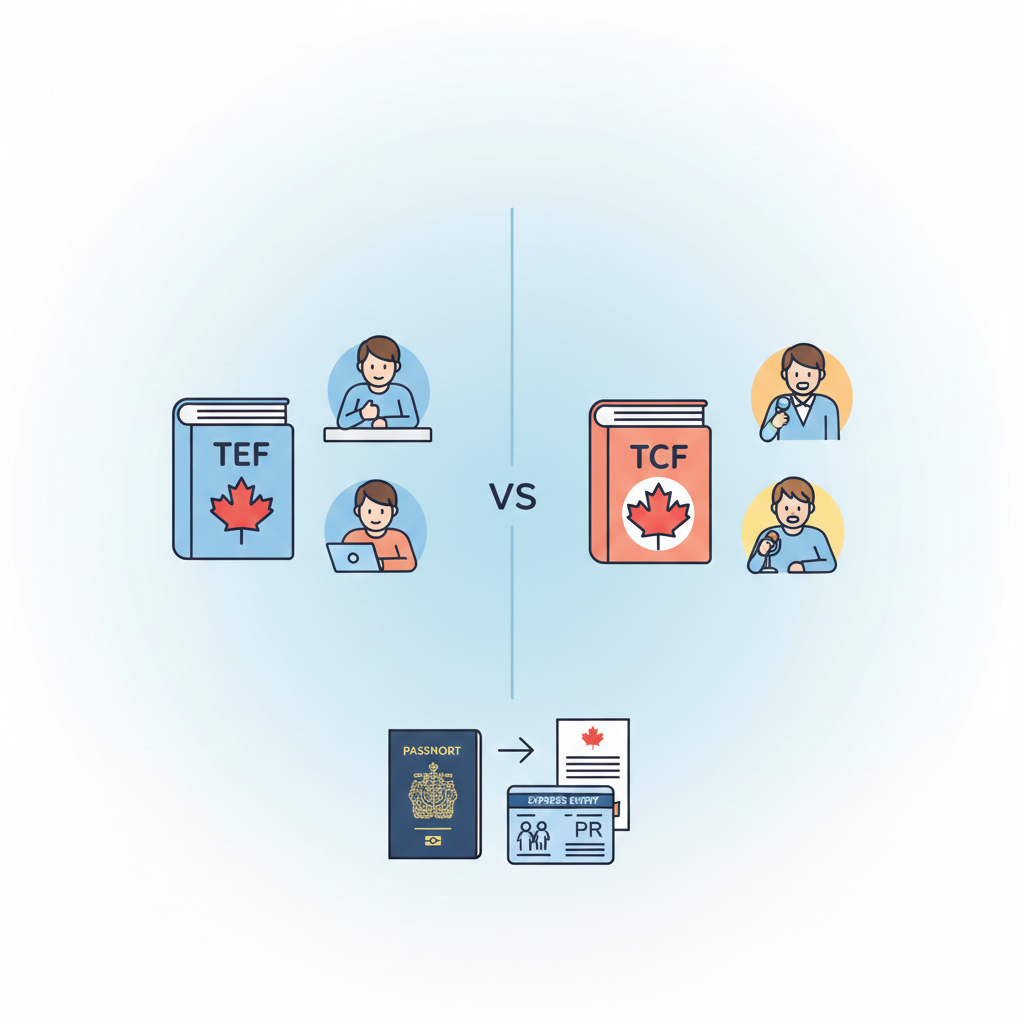
If you are planning for Canadian Permanent Residence (PR), trying to improve your Express Entry CRS score, or targeting French category-based draws, one of the most important decisions you will make is choosing between TEF Canada and TCF Canada. Both exams are accepted for Canadian immigration, but the format, task structure, and test-day experience can feel very different depending on your strengths.
At PrepFrench Classes, we help students prepare strategically for French exams used for immigration and career growth in Canada. If you are comparing exams, this guide will help you understand the difference clearly and choose the exam that fits your learning style, timeline, and immigration goals.
In this blog, you will learn:
- What TEF Canada and TCF Canada are
- Which exam is better for Express Entry and PR
- How French can improve your CRS score
- How to prepare for CLB/NCLC 7 in all 4 abilities
- Which course is right for you at PrepFrenchClass Courses
Not sure whether to choose TEF or TCF?
Book a FREE demo / consultation and we’ll help you choose the right exam path based on your current level, timeline, and immigration target.
What Is the Difference Between TEF Canada and TCF Canada?
TEF Canada (Test d’Évaluation de Français) and TCF Canada (Test de Connaissance du Français) are both officially accepted French language tests for Canadian immigration. For Express Entry, IRCC accepts both tests, and your results are converted to NCLC/CLB-equivalent levels for immigration scoring.
The most important thing to understand is this: the exam name itself does not give you extra points. Your immigration advantage comes from the language level you achieve, especially if you reach NCLC 7 (CLB-equivalent benchmark) in all four skills for French category-based eligibility and additional CRS benefits.
So instead of asking, “Which exam is better overall?”, the smarter question is: Which exam can I score higher in? That depends on your comfort with speaking structure, writing tasks, timing pressure, and test format.
TEF Canada for Canadian Immigration (Express Entry & PR)
TEF Canada is widely used by immigration applicants who want to improve their profile for:
- Express Entry profile creation and CRS score improvement
- Federal Skilled Worker Program (FSW) eligibility and competitiveness
- Canadian Experience Class (CEC) profile strengthening
- French language category-based rounds under Express Entry
- Canadian citizenship / other official uses (depending on the specific requirement)
TEF Canada is administered by CCI Paris Île-de-France (Le français des affaires), and many students choose it because the speaking and writing sections feel more compact in task count than TCF Canada. That said, test-day pacing and listening pressure can feel intense if you are not trained properly.
TEF Canada Exam Structure (Immigration Focus)
TEF Canada evaluates the four core language skills used in immigration scoring: listening, reading, writing, and speaking. As of current official exam information, TEF Canada includes:
- Listening Comprehension: multiple-choice, approximately 40 questions, 40 minutes
- Reading Comprehension: multiple-choice, approximately 40 questions, 60 minutes
- Written Expression: 2 sections, 60 minutes
- Oral Expression: face-to-face with examiner, 2 sections, around 15 minutes
A major point many students miss is that TEF listening requires active focus from start to finish. In the listening module, you generally cannot relax and “catch up later.” If your concentration drops for even a short time, you may lose multiple questions. That is why structured listening practice is essential for strong TEF scores.
In the reading section, candidates need more than vocabulary. You need the ability to identify the main idea, understand tone, compare answer choices, and make quick decisions under time pressure. Strong grammar awareness also helps because many answer traps rely on subtle wording differences.
The writing and speaking sections test how well you organize your thoughts, not just how many difficult words you know. A clear structure, appropriate tone, and logical argument flow often score better than overly complex sentences full of mistakes.
If you want guided preparation for TEF Canada, you can explore our structured Full TEF Canada (CLB 7) Course.
TCF Canada for Express Entry and PR
TCF Canada is another IRCC-accepted French language test used by candidates applying for PR and Express Entry. It is administered by France Éducation international and is also a strong option for immigration-focused learners.
Many students prefer TCF Canada because the speaking and writing sections are split into 3 progressive tasks. This structure can feel more guided and manageable for candidates who are nervous at the beginning of oral exams or who like task progression from simpler to more developed responses.
TCF Canada Exam Structure (Immigration Focus)
TCF Canada includes four mandatory modules for immigration purposes:
- Listening Comprehension: multiple-choice, 39 questions, around 35 minutes
- Reading Comprehension: multiple-choice, 39 questions, around 60 minutes
- Written Skills: 3 exercises, 60 minutes
- Verbal Skills (Speaking): 3 exercises, examiner interaction, around 12 minutes (with preparation time included)
The 3-task writing format is one of the biggest differences compared to TEF Canada. Some students find it easier because the tasks are segmented and progressive. Others find it challenging because they need excellent time management and quick task-switching skills. If you spend too much time on one task, your overall performance can drop even if your French is good.
In speaking, the gradual progression can help candidates who need a warm-up phase. However, you still need practice to stay organized, speak clearly, and develop your answers with examples. Good TCF performance comes from consistency, not improvisation.
If TCF Canada sounds like a better fit for your learning style, check our Full TCF Canada (CLB 7) Course for structured preparation.
TEF Canada vs TCF Canada: Side-by-Side Comparison for PR Applicants
Both exams are accepted for immigration, but the experience can be very different. Here is a practical comparison for students preparing for Express Entry, CRS improvement, and French category-based draws.
| Comparison Area | TEF Canada | TCF Canada |
|---|---|---|
| IRCC Acceptance | Accepted | Accepted |
| Listening Format | Fast-paced MCQ experience | Structured MCQ format |
| Writing Tasks | 2 sections | 3 exercises |
| Speaking Tasks | 2 sections | 3 progressive exercises |
| Best For (Typical Preference) | Students who prefer fewer expression tasks | Students who prefer progressive speaking/writing steps |
| What Matters Most for PR | Your final NCLC/CLB-equivalent score | Your final NCLC/CLB-equivalent score |
Bottom line: there is no universal “easier” exam. The best exam is the one in which you can score higher consistently in mock tests.
How French Improves Your CRS Score and PR Chances
French can become one of the strongest advantages in your immigration profile, especially if you are already in the Express Entry pool. Reaching the right French benchmark can help you:
- Increase your CRS score through language points and additional factors
- Qualify for French-language category-based selection (with minimum required French levels in all four abilities)
- Improve your overall competitiveness even if your CRS is lower in general rounds
- Strengthen your profile for future opportunities, including employment and settlement in Canada
Many students think French is only useful for PR after they already have a high CRS. In reality, French often becomes the strategy that helps applicants move from “not competitive enough” to “real chance of invitation.”
If you want a structured plan instead of random YouTube practice, browse all our options on the Courses page, including TEF/TCF prep and level-based classes (A1, A2, B1, B2).
Targeting PR through French?
We help students build a step-by-step plan to reach CLB/NCLC 7 in all 4 skills with mock tests, writing correction, and speaking feedback.
What Score Should You Target? (CLB/NCLC 7 and Beyond)
For most immigration-focused candidates, the most important target is:
NCLC 7 in all four abilities (Listening, Reading, Writing, Speaking)
This benchmark matters because French category-based eligibility and several immigration advantages depend on balanced performance. It is not enough to be excellent in speaking but weak in writing, or strong in reading but below target in listening. Immigration scoring and eligibility rely on your results across all four skills.
Advanced candidates may target higher levels for stronger CRS outcomes, but for many applicants, NCLC 7 is the key strategic milestone. Once that target is clear, your preparation becomes more focused and practical.
How to Choose the Right Exam for Your Learning Style
Use the following decision framework before registering:
Choose TEF Canada if you:
- Prefer fewer expression tasks (2 writing sections, 2 speaking sections)
- Are comfortable adapting quickly under exam pressure
- Perform well in fast-paced listening practice
- Like compact task structures and strong exam strategy coaching
Choose TCF Canada if you:
- Prefer a more progressive task flow
- Feel more confident with step-by-step speaking development
- Like structured task segmentation in writing
- Can manage time well across 3 writing exercises
If you are still unsure, the best method is simple: take a mock-style assessment for both formats and compare your performance. Students are often surprised by which format suits them better.
Preparation Strategy for TEF Canada and TCF Canada (CLB 7+)
A good score does not come from “studying French” in a general way. It comes from a structured exam strategy. Here is a practical preparation framework that works for both TEF and TCF:
1) Listening Practice (Daily)
Listening is often the section where students lose marks unexpectedly. To improve:
- Practice with exam-style audio regularly
- Train your ear for speed, accent variation, and instruction language
- Use short daily sessions instead of rare long sessions
- Review mistakes and identify patterns (numbers, dates, tone, implied meaning)
Consistent listening practice is especially important if you are targeting French category-based draws and need balanced scores across all abilities.
2) Reading Development (Speed + Accuracy)
Reading improves faster when you combine vocabulary with timed practice. Focus on:
- High-frequency vocabulary for emails, notices, ads, and formal communication
- Timed reading drills to improve speed without panic
- Question pattern analysis (main idea, detail, inference, tone)
- Grammar awareness to avoid answer traps
Many students can understand a text slowly, but the exam tests whether you can understand it within the time limit. That is why timing practice matters so much.
3) Writing Mastery (Format + Logic + Grammar)
Writing is often the difference between missing and reaching CLB/NCLC 7. The best approach is:
- Learn task-specific formats (formal communication, opinion, argument)
- Build strong paragraph structure (opening, development, closing)
- Use connectors correctly (cause, contrast, sequence, conclusion)
- Get regular feedback and correction from a teacher
Writing cannot improve well through self-study alone because many learners repeat the same grammar or organization errors without realizing it. Correction and feedback are essential.
4) Speaking Confidence (Clarity Over Speed)
To improve speaking:
- Practice timed speaking responses
- Record yourself and review fluency + grammar mistakes
- Simulate real examiner interaction
- Focus on clarity, structure, and examples instead of speaking too fast
In speaking exams, candidates often think they need “very advanced French” to score well. In reality, a clear and well-organized response with accurate grammar usually performs better than complicated language used incorrectly.
Common Mistakes Students Make in TEF/TCF Preparation
- Only studying vocabulary but not practicing exam tasks
- Ignoring writing correction and assuming “it’s good enough”
- Neglecting speaking practice because they feel shy
- Doing untimed practice only and then struggling in the real exam
- Memorizing full answers instead of learning how to build responses
- Starting too late for their current level
The best results come from balanced preparation: listening + reading + writing + speaking, with a clear score target and realistic timeline.
How Long Should You Prepare for TEF Canada or TCF Canada?
Preparation time depends on your starting level and consistency. A realistic estimate for many students is:
- Beginner (A0/A1): around 8–10 months for NCLC/CLB 7 with consistent guidance
- Elementary to Lower-Intermediate: around 4–6 months with focused exam training
- Upper-Intermediate: around 2–4 months for score refinement and mocks
Consistency matters more than intensity. Studying 1 hour daily for several months is usually more effective than cramming for a few weeks.
If you are not yet exam-ready, you can begin with foundational levels and progress through our complete pathway on the PrepFrenchClass Courses page, including A1, A2, B1, B2, and focused TEF/TCF prep.
Ready to Start Your French PR Journey?
Whether you choose TEF Canada or TCF Canada, the key is a smart plan, regular practice, and expert feedback. Book a FREE demo class / consultation and get a personalized roadmap based on your current level and immigration goal.
Recommended next step: Contact Us to Book Free Demo
Explore: Full TCF Canada Course | Full TEF Canada Course | All Courses
Frequently Asked Questions (FAQs)
1) Which exam is better for Canada PR: TEF Canada or TCF Canada?
Both are accepted for Canadian immigration. The better exam is the one where you can score higher based on your strengths, especially in writing and speaking. Your final immigration benefit depends on your NCLC/CLB-equivalent score, not the exam name.
2) Is French mandatory for Express Entry?
French is not mandatory for most Express Entry candidates, but it can significantly improve your CRS score and may help you qualify for French category-based draws if you meet the required French benchmark in all four skills.
3) What level of French is needed for French category-based draws?
A key target is NCLC 7 in all 4 abilities (listening, reading, writing, speaking). Always verify the latest official IRCC instructions when planning your application timeline.
4) How long are TEF Canada and TCF Canada results valid?
For immigration use, language test results must be valid at the relevant stages of your Express Entry process. As a general rule, applicants plan around a 2-year validity window and should always confirm validity before profile submission and PR application.
5) Can I retake TEF Canada or TCF Canada to improve my CRS score?
Yes. Many candidates retake the exam after structured preparation to improve their score and strengthen their Express Entry profile.
Final Verdict: TEF Canada vs TCF Canada
If your goal is Canadian PR through Express Entry, French category-based draws, or a stronger immigration profile, both TEF Canada and TCF Canada are excellent options.
The right choice depends on:
- Your current French level
- Your comfort with speaking and writing formats
- Your time available before the exam
- Your mock test performance
- The quality of your preparation strategy
If you want a guided plan instead of trial-and-error self-study, start with a free consultation at PrepFrenchClass.com and let us help you choose the right path.
✅ Next Step: Book Your FREE Demo / Consultation
Disclaimer: Exam formats, score interpretation grids, and immigration rules may be updated by official authorities. Always verify the latest details before booking your exam or submitting your profile.
Leave a Reply