Tag: French for professionals

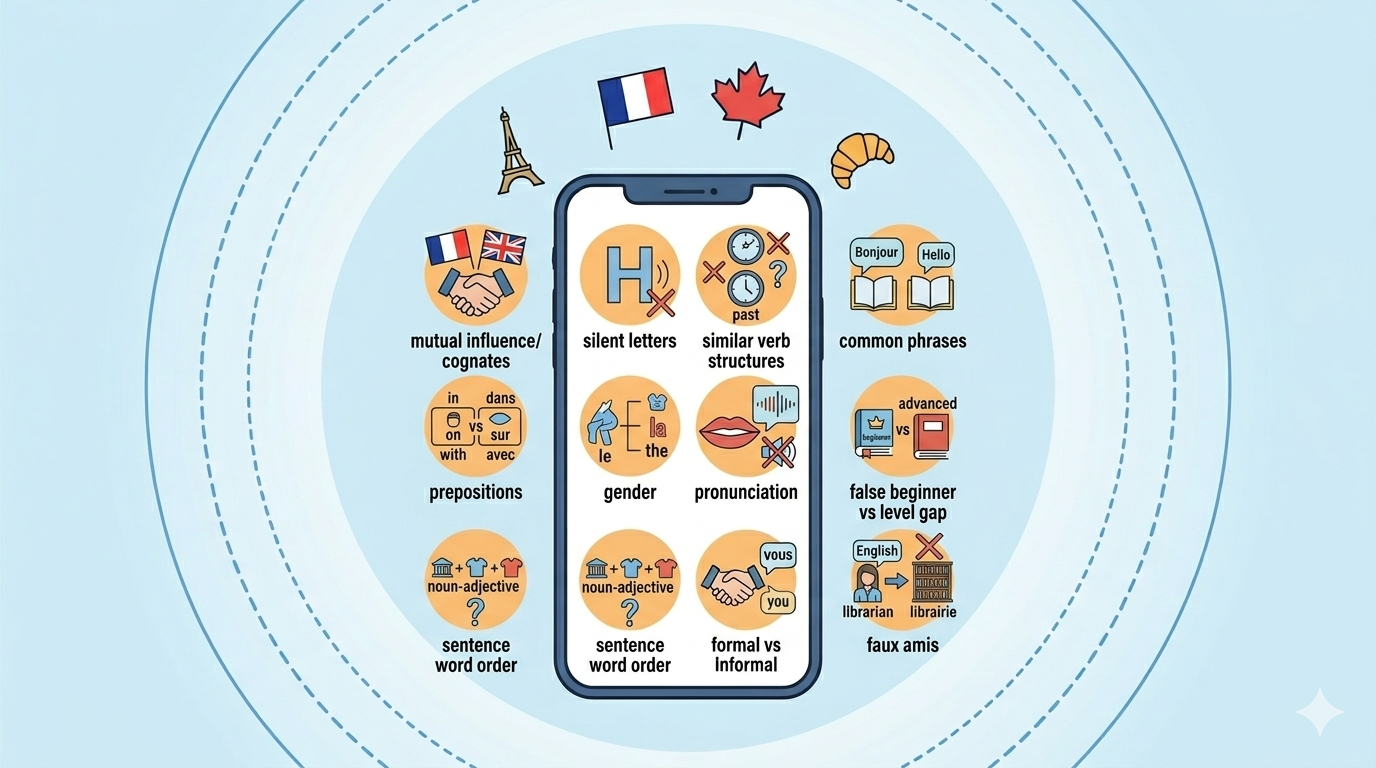
  • Learning French: Similarities and Differences Between English and French Explained

    Learning French: Similarities and Differences Between English and French Explained

    Learning French can feel much easier once you understand how closely connected English and French actually are. These two languages share centuries of historical interaction, thousands of similar words, and many cultural influences. At the same time, they differ in grammar, pronunciation, and communication style.

    For English speakers, recognizing these similarities and differences is one of the most powerful ways to accelerate language progress. In this comprehensive guide, we will explore how English and French evolved together, where they overlap, and where learners must adapt their thinking to truly master French.

    If you are starting your language journey, structured programs such as those available through PrepFrench Classes can help you understand these patterns more quickly and avoid common beginner mistakes.

    Tip: Understanding how English and French connect historically can significantly simplify vocabulary learning. Many words already exist in both languages with similar meanings.

    Table of Contents

    • Historical Connections Between English and French
    • Vocabulary Similarities and Cognates
    • Major Grammar Differences
    • Pronunciation Differences
    • Cultural Influences in Language
    • Practical Tips for English Speakers Learning French
    • FAQ

    Historical Connections Between English and French

    Understanding the historical relationship between English and French provides valuable insight when learning French. One of the most influential events shaping both languages was the Norman Conquest of England in 1066.

    After the conquest, French became the language of the English aristocracy and administration for several centuries. As a result, thousands of French words entered English vocabulary.

    Today, linguists estimate that roughly 30% of English vocabulary originates from French. Words related to law, governance, cuisine, and art frequently come from French origins.

    For deeper linguistic research on language development and frameworks, you can explore resources from the official CEFR language framework.

    During the Renaissance and later global expansion, English also influenced French in return. This mutual exchange means modern learners often recognize familiar patterns across both languages.

    Want Structured Guidance for Learning French?

    Our instructors help students understand grammar, vocabulary, and pronunciation step-by-step.

    Book Free Demo

    Explore Courses

    Vocabulary Similarities That Make Learning French Easier

    One of the biggest advantages English speakers have when learning French is the presence of cognates. Cognates are words that look similar and share similar meanings in both languages.

    Examples include:

    English French Meaning
    Restaurant Restaurant Dining place
    Artist Artiste Creative professional
    Justice Justice Legal fairness
    Culture Culture Societal traditions

    These shared words help learners quickly build vocabulary confidence. However, it is important to watch for false friends — words that appear similar but carry different meanings.

    For example:

    • Actuellement means “currently”, not “actually”.
    • Library translates to bibliothèque, not librairie.

    Understanding these distinctions is essential for effective communication while learning French.

    Grammar Differences Between English and French

    Despite vocabulary similarities, grammar differences can challenge English speakers when learning French. These differences require careful practice and exposure.

    Gendered Nouns

    Unlike English, French nouns are assigned grammatical gender.

    Examples:

    • le livre (the book – masculine)
    • la table (the table – feminine)

    Adjectives and articles must agree with the noun’s gender, which adds an extra layer of complexity.

    Verb Conjugation

    French verbs change depending on the subject and tense. For example:

    • Je parle
    • Tu parles
    • Nous parlons

    English verbs change less frequently, which is why conjugation may feel unfamiliar to new learners.

    Official explanations of language proficiency standards can be explored through resources such as France Éducation International.

    Study Tip: Instead of memorizing grammar tables alone, practice using verbs in real sentences and conversations.

    Pronunciation Differences When Learning French

    Pronunciation is one of the biggest hurdles when learning French. French includes several sounds that do not exist in English.

    Common pronunciation challenges include:

    • Nasal vowels (an, on, in)
    • The French “r” sound
    • Silent final consonants
    • Liaison between words

    Listening practice is essential. Educational research published through organizations such as OECD education studies emphasizes the importance of audio exposure when acquiring new languages.

    Consistent listening to native speech gradually trains your ear to identify these subtle sound differences.

    Improve Your Pronunciation with Expert Guidance

    Practice speaking with instructors who correct pronunciation and build confidence.

    Book Free Demo

    TCF Preparation | TEF Preparation

    Cultural Differences Reflected in Language

    Language reflects cultural values. When learning French, understanding cultural norms can help you communicate more naturally.

    One important example is the distinction between:

    • Tu – informal “you”
    • Vous – formal or plural “you”

    Using the wrong form can sometimes sound impolite. French culture tends to place strong emphasis on politeness and formality.

    Global cultural research conducted by institutions such as UNESCO cultural initiatives highlights how language structures often mirror societal values.

    By understanding cultural context, learners develop not only linguistic accuracy but also social awareness.

    Practical Tips for English Speakers Learning French

    To accelerate progress while learning French, consider these proven strategies:

    • Practice speaking daily
    • Watch French films or listen to podcasts
    • Learn phrases instead of isolated words
    • Review vocabulary consistently
    • Join structured language classes

    If your goal includes official certification or immigration pathways, structured preparation programs can significantly improve success rates.

    Explore training options through professional language programs designed for beginners and advanced learners.

    Conclusion

    Understanding the similarities and differences between English and French provides a powerful advantage when learning French. Shared vocabulary makes the language accessible, while grammar and pronunciation differences present stimulating challenges.

    With consistent practice, cultural awareness, and the right learning environment, English speakers can achieve fluency far more efficiently than they might expect.

    The key is to stay curious, practice regularly, and embrace both the similarities and the differences that make the French language so fascinating.

    Start Your French Learning Journey Today

    Join live online classes, structured lessons, and expert guidance.

    Book Free Demo

    Frequently Asked Questions

    What makes French easier for English speakers?

    Thousands of shared vocabulary words and historical connections make French more accessible to English speakers than many other languages.

    What is the biggest grammar difference between English and French?

    The system of gendered nouns and verb conjugations are two of the biggest grammar differences.

    Is French pronunciation difficult?

    French pronunciation includes nasal vowels and silent letters that require practice but become easier with listening exposure.

    How long does it take to learn French?

    With consistent study and practice, conversational proficiency often develops within 12–24 months.

    Can I learn French online?

    Yes. Online classes, speaking practice, and multimedia resources allow learners to develop strong language skills from anywhere.
  • 11 Common Mistakes to Avoid When Learning French

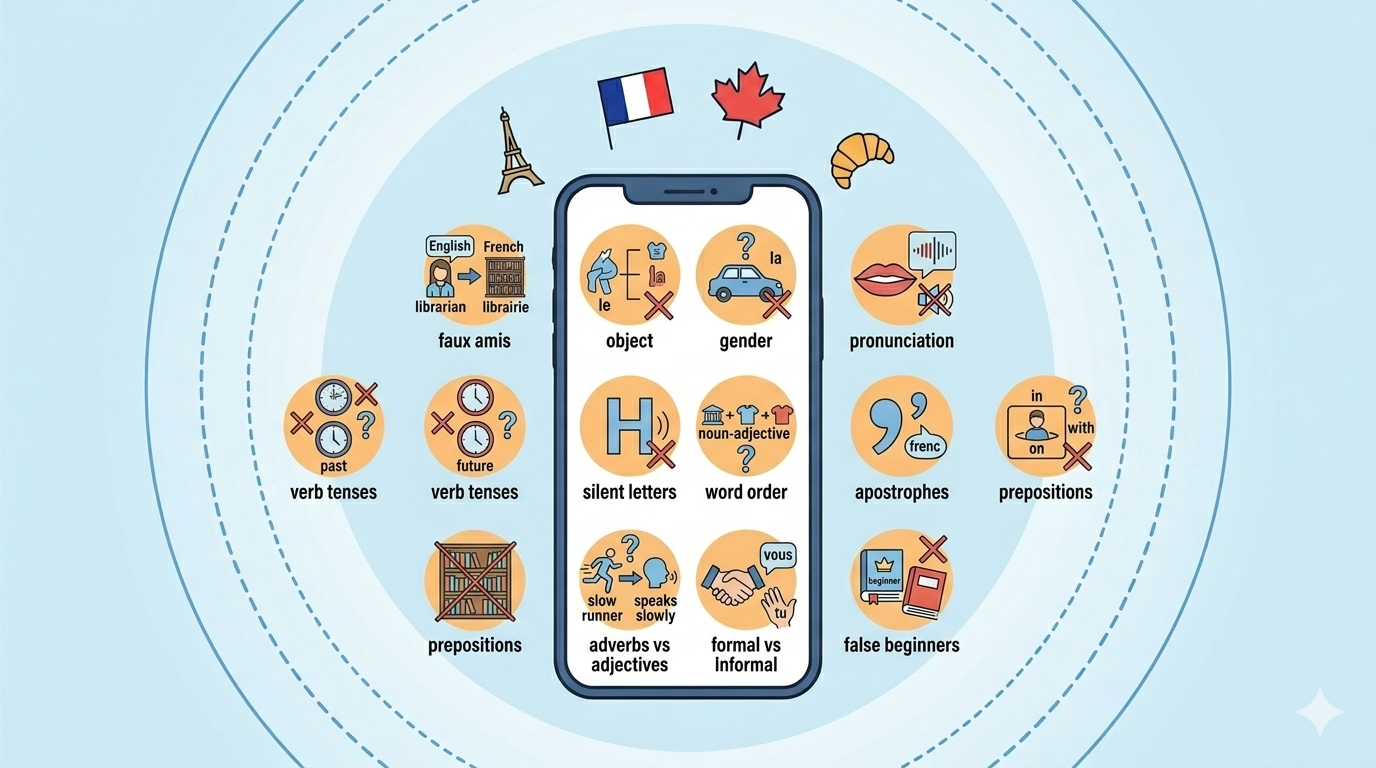
    11 Common Mistakes to Avoid When Learning French

    Learning French is one of the most rewarding intellectual and cultural journeys you can begin. Whether your goal is travel, immigration, career advancement, or simply personal enrichment, French opens doors to a global community of more than 300 million speakers. Yet despite its beauty, many learners struggle because they unknowingly repeat the same mistakes during the early stages of study.

    By understanding these challenges in advance, you can accelerate your progress and develop a more natural command of the language. In this guide, we will explore 11 of the most common mistakes learners make when studying French and provide practical strategies to overcome them. If you are serious about building real fluency, avoiding these pitfalls can dramatically improve your results.

    Quick Tip: A structured learning environment dramatically improves progress. Explore professional programs and structured lessons through our available programs designed for beginners and advanced learners alike.

    Table of Contents

    • Why Learning French Feels Challenging
    • 11 Common Mistakes Learners Make
    • How to Study French More Effectively
    • Practical Tips for Faster Progress
    • FAQ

    Why Learning French Feels Challenging

    Before discussing mistakes, it is helpful to understand why learning French can feel difficult for many students. French pronunciation, grammar structures, and verb conjugations differ significantly from English. For example, nasal vowels such as on, an, and in have no direct equivalent in English.

    Additionally, French grammar includes gendered nouns, agreement rules, and multiple verb tenses. These features make the language intellectually rich but sometimes confusing for beginners.

    According to the official CEFR language framework, mastering a new language requires developing competence in listening, reading, writing, and speaking simultaneously. Learners who focus too heavily on one skill often struggle with overall fluency.

    Fortunately, once you recognize common learning pitfalls, you can adopt strategies that accelerate your progress and make the experience far more enjoyable.

    Start Your French Journey the Right Way

    Join structured lessons with experienced instructors and interactive exercises designed to build real fluency.

    Book Free Demo

    TCF Preparation Program | TEF Preparation Program

    11 Common Mistakes to Avoid When Learning French

    1. Focusing Too Much on Grammar

    One of the biggest mistakes people make when learning French is obsessing over grammar rules. Grammar is important, but language exists to communicate. If you constantly worry about making mistakes, you may avoid speaking altogether.

    Instead, combine grammar study with conversation practice. Real communication helps reinforce grammatical structures naturally.

    2. Ignoring Pronunciation Early

    French pronunciation is extremely important. Small differences can completely change meaning. For instance, beaucoup and beau coup sound similar but differ in meaning.

    Pronunciation practice using phonetic exercises is essential. Many learners benefit from listening to native audio resources provided by institutions such as France Éducation International.

    3. Relying Only on Textbooks

    Textbooks are helpful, but they rarely reflect natural conversation. Real language includes slang, idioms, and cultural context.

    Supplement textbooks with French films, podcasts, and authentic materials. Listening to real speech improves comprehension significantly.

    4. Avoiding Conversation Practice

    Speaking is the most important skill when learning French, yet it is often neglected. Without conversation, vocabulary remains passive knowledge.

    Practice regularly with tutors, language partners, or online conversation groups. Studies from the OECD education research show that interactive learning dramatically increases language retention.

    5. Translating Everything in Your Head

    Many learners mentally translate every sentence from English to French. This habit slows down speaking and makes conversations stressful.

    Instead, try to think directly in French by associating words with images or actions rather than translations.

    6. Ignoring Cultural Context

    Language and culture are deeply connected. Understanding French culture helps you interpret expressions and communication styles.

    Resources from organizations such as UNESCO cultural programs highlight how cultural exposure improves language learning outcomes.

    7. Memorizing Without Context

    Vocabulary lists alone rarely lead to fluency. Words are easier to remember when learned within sentences or stories.

    For example, instead of memorizing manger, practice full sentences like: Je mange une pomme.

    8. Skipping Listening Practice

    Listening comprehension is essential when learning French. Native speech can initially sound fast and unclear.

    Use podcasts, interviews, and educational videos to train your ear. Over time, patterns become easier to recognize.

    9. Studying Inconsistently

    Consistency matters more than intensity. Studying for 15 minutes daily is often more effective than several hours once a week.

    Create a realistic study schedule that fits your lifestyle.

    10. Not Setting Clear Goals

    Clear objectives help maintain motivation. For example:

    • Passing an official language exam
    • Holding a 10-minute conversation
    • Reading French articles comfortably

    Official tests such as those explained on the CCI Paris official page measure language proficiency across multiple skills.

    11. Trying to Learn Alone Without Guidance

    While self-study is useful, structured instruction dramatically improves results. Teachers provide feedback, pronunciation correction, and accountability.

    Professional programs available at PrepFrench Classes combine grammar, speaking practice, and exam preparation for a balanced learning experience.

    Ready to Improve Your French Faster?

    Our instructors help students avoid common mistakes and build real conversational fluency.

    Book Free Demo

    View All Courses

    Practical Tips for Learning French Faster

    Avoiding mistakes is only part of the journey. Here are practical strategies that help accelerate progress while learning French.

    Strategy Benefit
    Daily listening practice Improves comprehension and pronunciation
    Speaking with tutors Builds real communication confidence
    Learning phrases instead of single words Speeds up conversational fluency
    Cultural immersion Improves understanding of real-life communication
    Tip: If your goal involves immigration or professional certification, structured preparation programs can help you reach the required language levels efficiently.

    Conclusion

    Mastering a language requires patience, consistency, and the right strategy. By recognizing these common mistakes early, you can approach learning French with a smarter and more effective study plan.

    Focus on balanced learning: combine grammar, pronunciation, listening, and conversation practice. Engage with authentic cultural content and maintain a regular study schedule.

    With the right guidance and dedication, achieving French fluency is absolutely possible.

    Start Speaking French with Confidence

    Join live classes, structured lessons, and expert guidance designed for real-world fluency.

    Book Free Demo

    Frequently Asked Questions

    What is the biggest challenge when learning French?

    Pronunciation and verb conjugation are often the biggest challenges, especially for beginners.

    How long does it take to become fluent in French?

    It depends on study intensity, but consistent learners often reach conversational fluency within 12–24 months.

    What is the best way to practice speaking French?

    Practice with tutors, conversation groups, or structured language classes.

    Can I learn French without living in a French-speaking country?

    Yes. Online lessons, media exposure, and speaking practice allow learners to develop strong fluency remotely.

    Are official French exams necessary?

    They are not required for everyone, but certifications can be helpful for immigration, university admission, or employment.

  • Unlocking Opportunities: The Top 9 Benefits of Mastering the French Language

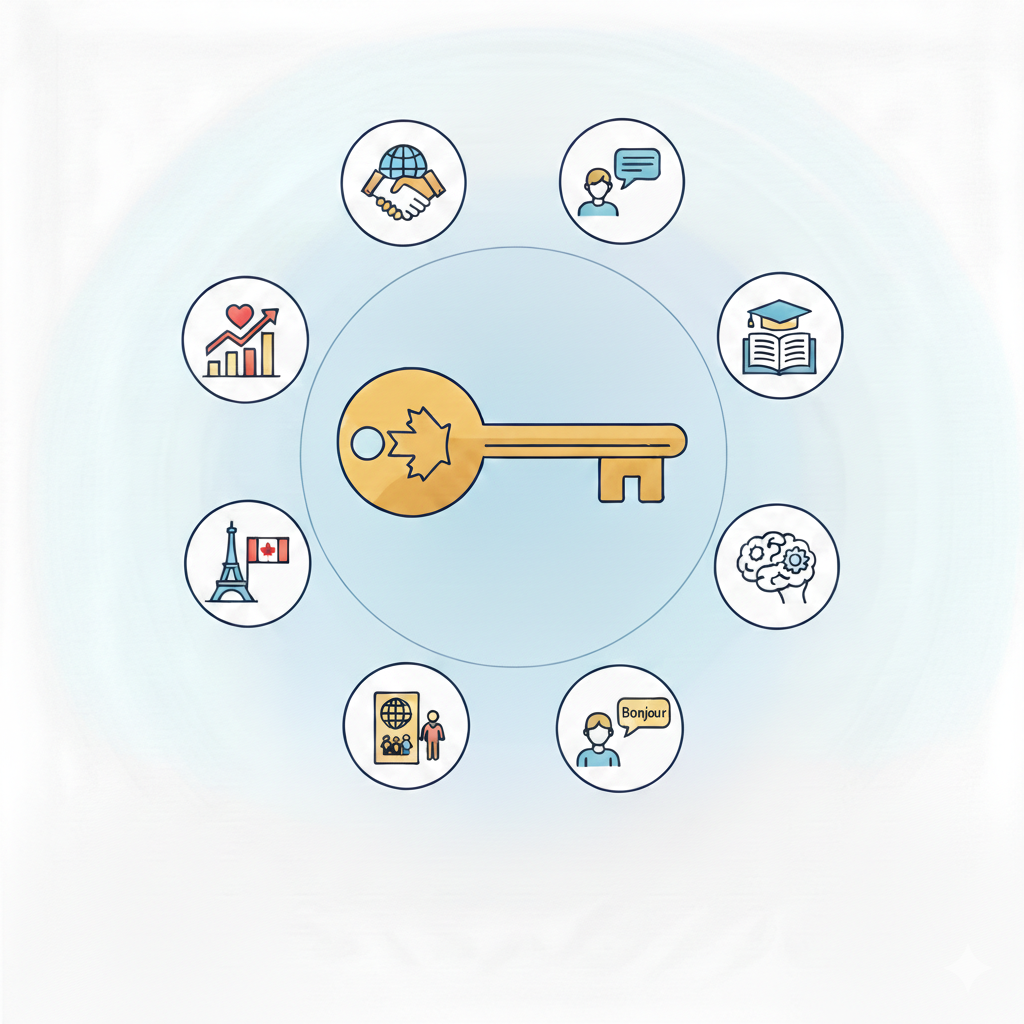
    Unlocking Opportunities: The Top 9 Benefits of Mastering the French Language

    In today’s interconnected world, learning a new language is much more than an academic achievement. It is a practical skill that can improve your career options, travel experiences, cultural understanding, and confidence. Among the most valuable global languages, French stands out because of its international presence across education, diplomacy, business, culture, and immigration pathways.

    French is used across multiple continents and is also one of the official languages of major international institutions, including the United Nations. This makes French a highly relevant language for students, professionals, newcomers, and globally minded learners. (UN Official Languages)

    Whether your goal is to improve your professional profile, prepare for TEF Canada / TCF Canada, travel more confidently, or simply challenge yourself with a meaningful new skill, mastering French can open doors in ways many learners do not expect.

    At PrepFrench Classes, we help learners build French skills for real-life outcomes through structured learning pathways, live instruction, and goal-based support.

    In this article, we explore the top 9 benefits of mastering French and how PrepFrench can support your journey.

    Thinking about learning French but not sure where to start?

    Book a FREE demo class / consultation with PrepFrench Classes and get a personalized learning plan based on your goal (career, travel, exam prep, immigration, or fluency).

    Book Free Demo

    Why French Matters Globally in 2026

    Before we dive into the 9 benefits, it helps to understand why French remains such a strategic language. French is used in many regions across Europe, Africa, North America, and beyond, and it is supported by a wide global Francophone community. (OIF – The Francophonie in Brief)

    It is also a language closely tied to diplomacy, education, global mobility, arts, and cultural exchange. That means learning French can create value in both practical and personal areas of life.

    If you want a structured path instead of random self-study, explore our full learning options here: PrepFrench Courses.

    1) Expand Career Opportunities with French

    One of the strongest benefits of mastering French is the impact it can have on your career. In a globalized economy, employers value professionals who can communicate with clients, partners, and teams across language and cultural boundaries.

    French can be particularly helpful in industries such as:

    • Tourism and hospitality
    • International business and sales
    • Education and training
    • Government and public service
    • NGOs and international development
    • Customer support and multilingual operations

    In Canada, French can also be especially valuable for bilingual roles in public service and many customer-facing or administrative positions. (Canada Public Service – Bilingual Positions FAQs)

    Even when a role does not explicitly require French, the skill can make your profile stand out by signaling adaptability, discipline, and international communication ability.

    At PrepFrench, we help learners build practical French that supports real goals, not just textbook exercises. Visit our Home Page to learn more about our approach.

    2) Improve Your Earning Potential and Professional Value

    While salary outcomes always depend on industry, location, and role, multilingual professionals are often viewed as more versatile and valuable in organizations that serve diverse markets. French can improve your ability to contribute in cross-border communication, client support, and team collaboration.

    This can translate into benefits such as:

    • Access to a wider range of roles
    • Eligibility for bilingual or multilingual positions
    • Stronger client-facing or leadership opportunities
    • Better competitiveness in international environments

    The key point is not just “knowing French,” but being able to use French confidently in professional settings. That is why structured practice in speaking, listening, and workplace-style communication matters so much.

    3) Unlock Rich Cultural Experiences Through French

    Learning French is not only about grammar and vocabulary. It is also a gateway to literature, cinema, music, philosophy, and art across many Francophone cultures. When you understand French, you can engage with cultural works more deeply and appreciate nuance that often gets lost in translation.

    French gives you direct access to:

    • Literature in the original language
    • Films and documentaries with cultural context
    • Music and lyrics beyond translations
    • Art and philosophy through primary sources and commentary

    It also helps you enjoy major cultural events and institutions with greater appreciation, such as the Festival de Cannes and France’s Fête de la Musique.

    At PrepFrench, we encourage learners to connect language with culture so French becomes meaningful, memorable, and enjoyable.

    Want to learn French for real-life use, not just exam answers?

    Our courses combine grammar, speaking, and practical communication so you can use French confidently in work, travel, and daily life.

    Explore Courses

    4) Travel More Confidently in French-Speaking Regions

    Travel becomes much more enjoyable when you can communicate directly with locals. French can help you navigate airports, hotels, restaurants, local transport, and everyday interactions with much greater confidence.

    When you speak even intermediate French, you can:

    • Read menus, signs, and travel instructions more easily
    • Ask better questions and understand local responses
    • Handle small problems (bookings, directions, purchases) more smoothly
    • Build authentic connections with local people

    This applies not only to France, but also to many parts of Canada, Belgium, Switzerland, and several African countries where French is widely used in public life.

    PrepFrench includes practical speaking support that can help learners prepare for travel-focused communication and common real-world situations.

    5) Support Immigration Goals, Especially for Canada

    For many learners, French is a strategic asset for immigration planning. In Canada, French language proficiency can support immigration pathways and strengthen profiles in programs where language ability is formally assessed.

    Immigration, Refugees and Citizenship Canada (IRCC) accepts approved French language tests for relevant applications and profiles, including TEF Canada and TCF Canada. (IRCC – Language Test Results for Express Entry)

    If your goal is Canadian immigration or PR profile improvement, French can become much more than a language skill. It can become a long-term opportunity multiplier.

    For exam-focused preparation, explore:

    A structured plan matters here because immigration-oriented French goals usually require balanced performance across reading, writing, listening, and speaking.

    6) Gain Cognitive Benefits from Bilingual Learning

    Learning French can also benefit your brain. Research on bilingualism suggests that using more than one language may be associated with improved attentional control, mental flexibility, and certain executive function skills. However, the strength of these effects can vary across studies and populations.

    In practical terms, language learning often trains you to:

    • Pay closer attention to patterns and context
    • Switch between rules and systems more effectively
    • Develop stronger memory habits through repetition and retrieval
    • Improve listening precision and mental processing speed over time

    Some research also explores how lifelong bilingualism may contribute to cognitive reserve, though evidence is mixed and continues to evolve. (APA – Being Bilingual) | (NIH/PMC Review – Critical Overview)

    At PrepFrench Classes, our teaching method emphasizes active engagement, not passive memorization, helping learners build both language skills and stronger learning habits.

    7) Build a Global Network of Friends and Professional Connections

    Language learning changes who you can connect with. When you speak French, you gain access to broader communities across countries, industries, student networks, and cultural groups.

    This can create opportunities for:

    • International friendships and cultural exchange
    • Professional networking across Francophone regions
    • Community participation in French-speaking events
    • Online groups, forums, and collaborative spaces in French

    Even basic conversational French can make a major difference in how people respond to you. It shows respect, curiosity, and willingness to connect.

    PrepFrench encourages learners to practice French actively so they can move from “understanding French” to actually using it in social and professional contexts.

    8) Expand Access to Education and Academic Opportunities

    Mastering French can expand your academic options significantly. French proficiency can support admission, study readiness, and cultural integration for learners interested in programs in French-speaking environments.

    For students considering higher education in France or other Francophone destinations, French can improve access to academic programs and everyday life on campus. Resources such as Campus France help international students explore study pathways, institutions, and application procedures.

    In many fields such as international relations, arts, humanities, and social sciences, French can also broaden your access to sources, lectures, research, and academic discussions.

    If your goal is academic progress, starting with a structured level-based course path (A1 to B2 and beyond) is often the best foundation. Browse your options on our Courses Page.

    Need a French plan for PR, studies, or career growth?

    We help students choose the right pathway, from beginner French (A1-A2) to intermediate/advanced levels and exam prep (TEF Canada / TCF Canada).

    Get Free Guidance

    9) Increase Personal Satisfaction, Confidence, and Self-Discipline

    Beyond professional or academic advantages, learning French can be deeply rewarding on a personal level. Mastering a language builds patience, discipline, and resilience because progress happens through consistent effort over time.

    Many learners report that French helps them:

    • Feel a stronger sense of achievement
    • Build confidence in speaking and social situations
    • Become more comfortable making mistakes and learning from them
    • Develop better study habits and long-term consistency

    Confidence is one of the biggest transformations we see at PrepFrench. Students who once hesitated to say a simple sentence often become much more expressive, curious, and self-assured after consistent guided practice.

    Quick Summary: The 9 Benefits of Mastering French

    Benefit How It Helps
    1. Career opportunities Expands job options in multilingual and international roles
    2. Professional value Improves competitiveness and role flexibility
    3. Cultural enrichment Deeper access to literature, films, music, and arts
    4. Better travel experiences Easier navigation and stronger local connections
    5. Immigration support Helps in language-based pathways and profile strength
    6. Cognitive benefits Supports mental flexibility and strong learning habits
    7. Global network Enables friendships and professional connections worldwide
    8. Education access Opens academic pathways and French-speaking study environments
    9. Personal growth Builds confidence, discipline, and long-term motivation

    How PrepFrench Classes Helps You Turn French into Real Opportunities

    At PrepFrench Classes, we focus on practical progress and structured outcomes. Whether you are learning French for work, travel, studies, or immigration, our programs are designed to help you move forward with confidence.

    We support learners through:

    • Structured level progression (beginner to advanced pathways)
    • Live guided classes with feedback and accountability
    • Speaking practice and pronunciation support
    • Exam-oriented preparation for TEF Canada and TCF Canada
    • Goal-based planning for PR, studies, and professional use

    If you are serious about learning French in a way that creates real results, a guided learning plan can save time and improve your confidence significantly.

    Ready to Unlock the Benefits of French in Your Life?

    Whether your goal is career growth, immigration, travel, studies, or personal confidence, French can become one of the most valuable skills you build this year. Book a FREE demo class / consultation and get a personalized roadmap from PrepFrench Classes.

    👉 Book Your Free Demo / Consultation

    Explore: All Courses  |  Full TCF Canada Course  |  Full TEF Canada Course  |  Home

    Frequently Asked Questions (FAQ)

    1) What are the biggest benefits of learning French?

    The biggest benefits include better career opportunities, stronger travel experiences, cultural enrichment, academic access, immigration support in some pathways, and improved confidence through mastering a valuable global skill.

    2) Is French useful for jobs in Canada?

    Yes. French can be valuable for bilingual roles, public service pathways, customer-facing positions, and organizations serving French-speaking communities. It can also improve competitiveness in many professional environments.

    3) Can learning French help with Canadian immigration?

    French language proficiency can support certain immigration-related goals and profile strength, especially when demonstrated through approved tests such as TEF Canada or TCF Canada (depending on the program requirements).

    4) How long does it take to become fluent in French?

    It depends on your starting level, study consistency, learning method, and target outcome. With regular practice and structured support, many learners see major improvements within a few months, while fluency is a longer-term journey.

    5) What is the best way to learn French effectively?

    The most effective approach usually combines structured lessons, daily practice, speaking opportunities, listening exposure, and feedback. A guided course can help you stay consistent and avoid common learning plateaus.

    Final Thoughts

    Mastering French is one of those goals that creates value in multiple areas of life at the same time. It can improve your career options, help you travel with confidence, support immigration and academic plans, and give you a lasting sense of achievement.

    If you want to learn French with structure, motivation, and real outcomes in mind, PrepFrench Classes can help you build a practical roadmap based on your goals.

    ✅ Next Step: Book Your FREE Demo / Consultation


    Disclaimer: Immigration requirements, language test rules, and institutional policies may change over time. Always confirm current details on official websites before making application or exam decisions.

  • The Importance of French Certification: Unlocking Opportunities in Language Proficiency

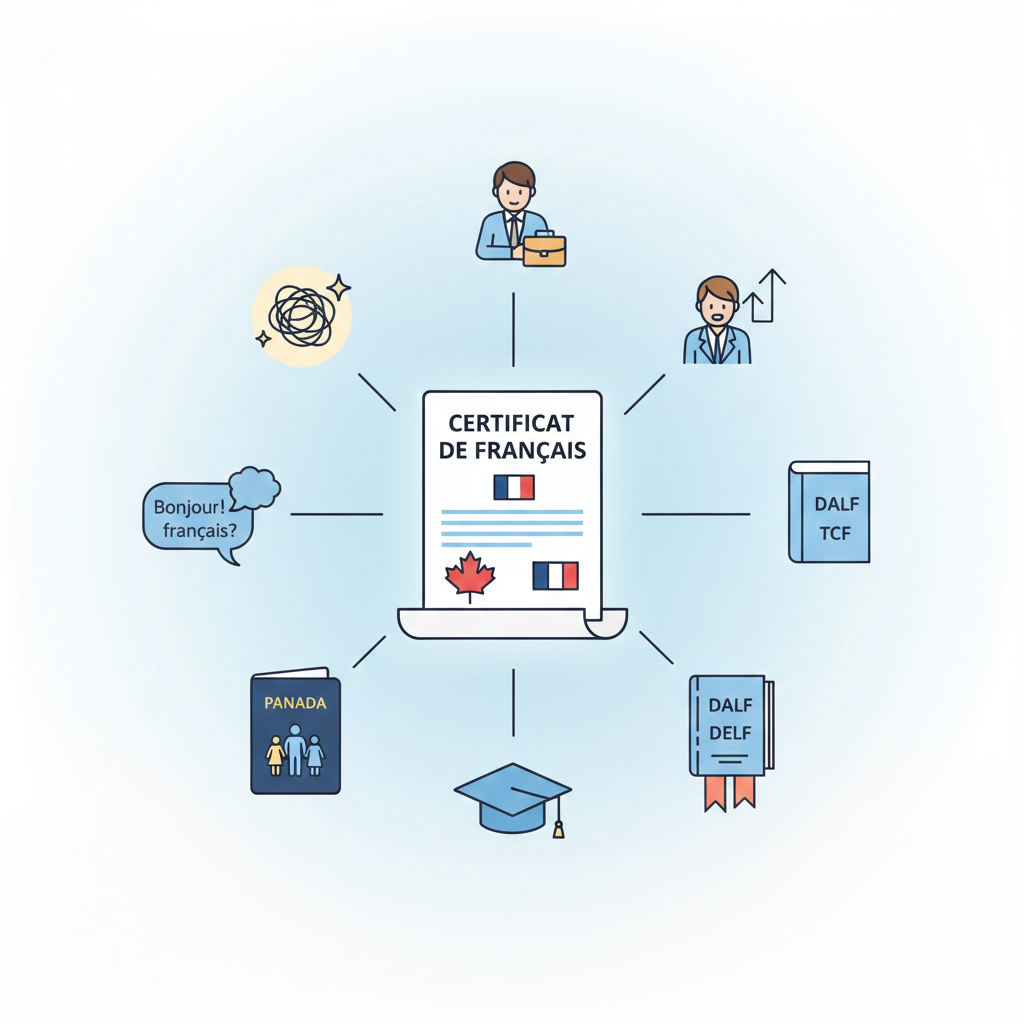
    The Importance of French Certification: Unlocking Opportunities in Language Proficiency

    In today’s global and interconnected world, learning a second language is no longer just a personal hobby—it can be a powerful advantage for your career, immigration plans, education, and self-growth. Among the most valuable global languages, French stands out because of its international use across business, diplomacy, education, and multicultural communities.

    But learning French is one thing. Proving your French proficiency through certification is what opens real doors.

    A French certification gives you formal proof of your language ability. Whether your goal is to improve your professional profile, prepare for immigration, qualify for opportunities in French-speaking environments, or simply measure your progress seriously, a recognized French certification can make a major difference.

    At PrepFrench Classes, we help learners build strong French foundations and prepare for real outcomes—including structured language learning and exam-focused preparation such as TEF Canada and TCF Canada.

    In this guide, we’ll explore:

    • Why French certification matters in today’s job market
    • How French certification supports immigration pathways
    • How certification improves confidence and personal growth
    • What certification options and study pathways are available
    • How to choose the right French certification path for your goals

    Want to build French for career, PR, or confidence—but not sure where to start?

    Book a FREE demo class / consultation and get a personalized French learning plan based on your goal (beginner, exam prep, immigration, or professional use).

    Book Free Demo

    What Is a French Certification and Why Does It Matter?

    A French certification is an official or recognized proof of your ability to understand and use the French language in listening, reading, writing, and speaking. It helps others—employers, institutions, immigration authorities, and even you—assess your language level in a more objective way.

    Many learners study French for months (or years) but struggle to answer a simple question: “What is your level?” Certification solves this problem by giving your skills structure, credibility, and direction.

    French certification matters because it:

    • Validates your skills with measurable outcomes
    • Strengthens your resume and professional profile
    • Supports immigration applications in language-based pathways
    • Creates motivation and accountability in your learning journey
    • Helps you set real goals instead of learning without direction

    In short, certification transforms French from “something you are learning” into a skill you can confidently present and use.

    The Value of French Language Skills in Today’s Global Workforce

    Employers increasingly value professionals who can communicate across languages and cultures. French is especially useful because it is used in international business, customer service, education, diplomacy, tourism, and multilingual teams across multiple regions.

    In many workplaces, French proficiency is not only a “nice-to-have” skill—it can become a practical advantage for client communication, cross-border collaboration, and career growth.

    Why French Skills Improve Employability

    A candidate with French proficiency may stand out because they can contribute to:

    • Multilingual communication with clients or teams
    • Regional market support in French-speaking communities
    • Better customer experience in bilingual service environments
    • Stronger collaboration in global companies and institutions

    Even when a job does not strictly require French, certification can still signal discipline, adaptability, and international communication ability—qualities that many employers respect.

    Industries Where French Certification Can Help

    French certification can be especially valuable in sectors such as:

    • Tourism and hospitality (guest communication, travel support)
    • Customer service and sales (bilingual communication)
    • Education and training (teaching, tutoring, program support)
    • International business (cross-border communication and operations)
    • Government and public service (especially in bilingual contexts)
    • Healthcare and community services (serving diverse populations)

    For students and young professionals, certification can also help during internships, university applications, scholarship opportunities, and networking in multicultural environments.

    If your goal is long-term career growth through French, explore the learning path options on our Courses Page.

    French Certification and Immigration: Why It Can Be a Game-Changer

    For many learners, French certification is not just about career development—it is also a major step toward immigration goals. In countries and programs where language proficiency is assessed formally, certification can significantly impact eligibility and competitiveness.

    For example, in Canadian immigration pathways, approved language tests are used to demonstrate language ability for programs and profile scoring. French test results can strengthen a candidate’s immigration profile when used strategically.

    How French Certification Helps Immigration Goals

    • Provides official proof of language proficiency for eligible pathways
    • Supports profile strength in competitive immigration systems
    • Improves integration potential for work, community, and daily life
    • Expands opportunities in bilingual or French-speaking regions

    In Canada, learners commonly prepare for recognized tests such as TEF Canada and TCF Canada when planning French-based immigration strategies or strengthening their Express Entry profile.

    If your goal is immigration-focused French preparation, you can explore:

    A major advantage of certification-focused preparation is that it gives you a clear target. Instead of “learning French in general,” you prepare with a measurable goal, timeline, and skill benchmark.

    Planning PR or immigration pathways that benefit from French?

    We offer guided preparation for TEF Canada and TCF Canada with structured lessons, mock practice, and feedback.

    Talk to an Advisor / Book Free Demo

    Career, Immigration, and Beyond: Certification Builds Real Confidence

    One of the most overlooked benefits of French certification is confidence. Many learners study for a long time but still hesitate to speak because they are unsure of their level. Certification helps solve this by giving you a concrete milestone and proof of progress.

    When learners prepare for a recognized exam or proficiency standard, they often become more disciplined and focused. They begin to practice all four skills more consistently, and their communication becomes stronger in real situations.

    How Certification Supports Personal Growth

    • Creates a sense of achievement through measurable milestones
    • Builds speaking confidence through structured practice
    • Improves consistency because learners have a clear target
    • Encourages resilience through challenges and progress tracking
    • Expands cultural understanding through deeper language engagement

    This is especially important for beginners who often feel stuck between “I know some French” and “I can actually use French confidently.” Certification bridges that gap by turning effort into recognized progress.

    At PrepFrench Classes, we regularly see students become more motivated once they begin working toward a defined milestone—whether that is a level goal, an exam target, or a professional objective.

    Common French Certification Goals (and Which Learners They Help)

    Not all learners pursue certification for the same reason. Understanding your goal is the first step to choosing the right preparation pathway.

    Learner Goal Why Certification Helps Recommended Path
    Career advancement Adds credibility to resume and communication ability Level-based French + practical communication training
    Immigration / PR planning Provides approved test-based language proof where required TEF Canada / TCF Canada preparation
    Academic goals Demonstrates language level for programs and applications Structured level progression + exam preparation
    Personal mastery and fluency Creates motivation, milestones, and measurable progress A1–B2 pathway + speaking-focused practice

    This is why choosing a course should begin with your goal—not just the exam name. If you’re unsure which path fits your situation, a quick consultation can save you months of unfocused study.

    TEF Canada and TCF Canada: Why Exam-Focused Certification Prep Matters

    When learners hear “French certification,” they often assume general French classes alone are enough. While foundational French is essential, exam-based certifications like TEF Canada and TCF Canada require a specific preparation strategy.

    That’s because certification exams do not only test what you know—they test how you perform under timed conditions across listening, reading, writing, and speaking.

    Why Students Need Structured Certification Prep

    • Exam format familiarity (task types, timing, instructions)
    • Skill balance across all four abilities
    • Writing correction and response structure practice
    • Speaking feedback for fluency, clarity, and organization
    • Mock tests to measure progress realistically

    Many students study grammar and vocabulary for months but still underperform on exams because they have not trained for test conditions. Certification success comes from combining language learning + exam strategy.

    If your focus is immigration-oriented French certification, our specialized programs are designed to help learners prepare efficiently:

    Online vs In-Person French Certification Preparation: Which Is Better?

    Today, learners have more options than ever before. You can prepare for French certification through online learning, in-person classes, or a blended approach. The best format depends on your schedule, learning style, and need for accountability.

    Benefits of Online French Certification Preparation

    • Flexible scheduling for working professionals and students
    • Access from anywhere without commuting
    • Recorded sessions / review options (where available)
    • Comfortable learning environment for shy beginners

    Benefits of Live Structured Classes (Even Online)

    • Teacher guidance and error correction
    • Regular speaking practice and accountability
    • Clear progression instead of random self-study
    • Motivation through routine and feedback

    Many learners start with apps or self-study but eventually realize they need a structured system to reach certification-level performance. That is where guided coaching becomes valuable.

    You can browse all PrepFrench learning options here: View All Courses.

    Confused between general French classes and exam prep?

    We’ll help you choose the right path—beginner foundation, level progression, TEF Canada prep, or TCF Canada prep—based on your goal and timeline.

    Book Free Guidance Call

    Resources That Help You Succeed in French Certification

    Certification success is easier when you use a combination of resources instead of relying on only one method. Strong learners usually combine class guidance, structured practice, and independent reinforcement.

    Helpful Resources for French Certification Preparation

    • Structured classes for step-by-step learning and correction
    • Practice exercises for grammar, vocabulary, and comprehension
    • Listening and speaking practice for real language use
    • Mock exams to simulate certification conditions
    • Writing feedback to improve clarity and accuracy
    • Study schedules that make progress consistent and realistic

    A common reason learners delay certification is feeling overwhelmed by resources. The solution is not collecting more materials—it is following a plan. A good program helps you focus on the right tasks at the right stage.

    How PrepFrench Classes Helps Learners Turn French into Opportunity

    At PrepFrench Classes, our goal is not just to teach French—it is to help students use French to unlock real opportunities.

    We support learners at different stages:

    • Beginners who need a strong foundation in pronunciation, grammar, and speaking
    • Intermediate learners who want structure and confidence
    • Exam-focused students preparing for TEF Canada or TCF Canada
    • Immigration-focused learners building a language strategy for PR or profile improvement

    Our courses emphasize:

    • Clear progression and organized curriculum
    • Practical communication and speaking confidence
    • Targeted support for certification goals
    • Guided feedback and accountability

    Whether you are starting from scratch or preparing for a certification exam, we help you move from uncertainty to structured progress.

    Ready to Earn a French Certification and Unlock New Opportunities?

    Whether your goal is career growth, immigration preparation, or personal achievement, a structured French certification plan can save time and deliver better results. Book a FREE demo class / consultation and get a personalized roadmap from PrepFrench Classes.

    👉 Contact Us to Book Your Free Demo

    Explore: All Courses  |  Full TCF Canada Course  |  Full TEF Canada Course  |  Home

    Frequently Asked Questions (FAQ)

    1) Why is French certification important?

    French certification is important because it provides official proof of your language ability. It can improve your resume, support immigration pathways, strengthen academic applications, and build confidence by giving you measurable milestones.

    2) Is French certification useful for jobs?

    Yes. In many industries, French certification helps candidates stand out by demonstrating communication skills, adaptability, and readiness for multilingual environments. It can be especially useful in customer-facing, international, education, public service, and hospitality roles.

    3) What is the difference between TEF Canada and TCF Canada?

    TEF Canada and TCF Canada are both recognized French tests used for Canadian immigration-related language proof. They differ in exam structure and task format, but both assess listening, reading, writing, and speaking. The best choice depends on your goals and which format suits you better.

    4) How long does it take to prepare for a French certification?

    Preparation time depends on your current level, target score/level, and study consistency. Some learners prepare over a few months, while others follow a longer structured path. A guided study plan usually improves results and saves time.

    5) Can beginners start preparing for French certification?

    Absolutely. Beginners should first build a strong foundation in grammar, vocabulary, pronunciation, listening, and speaking. From there, they can progress toward certification-focused preparation with a structured course plan.

    Final Thoughts: French Certification Is More Than a Certificate

    French certification is not just a paper credential. It is a practical tool that can help you unlock real opportunities in work, immigration, education, and personal growth. It gives your learning direction, your progress credibility, and your future plans stronger support.

    Whether you are learning French to expand your career, strengthen your immigration profile, or challenge yourself personally, certification can be a powerful milestone in your journey.

    If you want to start with the right strategy, visit PrepFrenchClass.com or book a free consultation to get a personalized plan.

    ✅ Next Step: Book Your FREE Demo / Consultation


    Disclaimer: Certification formats, immigration requirements, and accepted tests may change over time. Always confirm current requirements with official authorities and exam providers before registering or applying.