Category: French Culture

  • Learning French: Similarities and Differences Between English and French Explained

    Learning French: Similarities and Differences Between English and French Explained

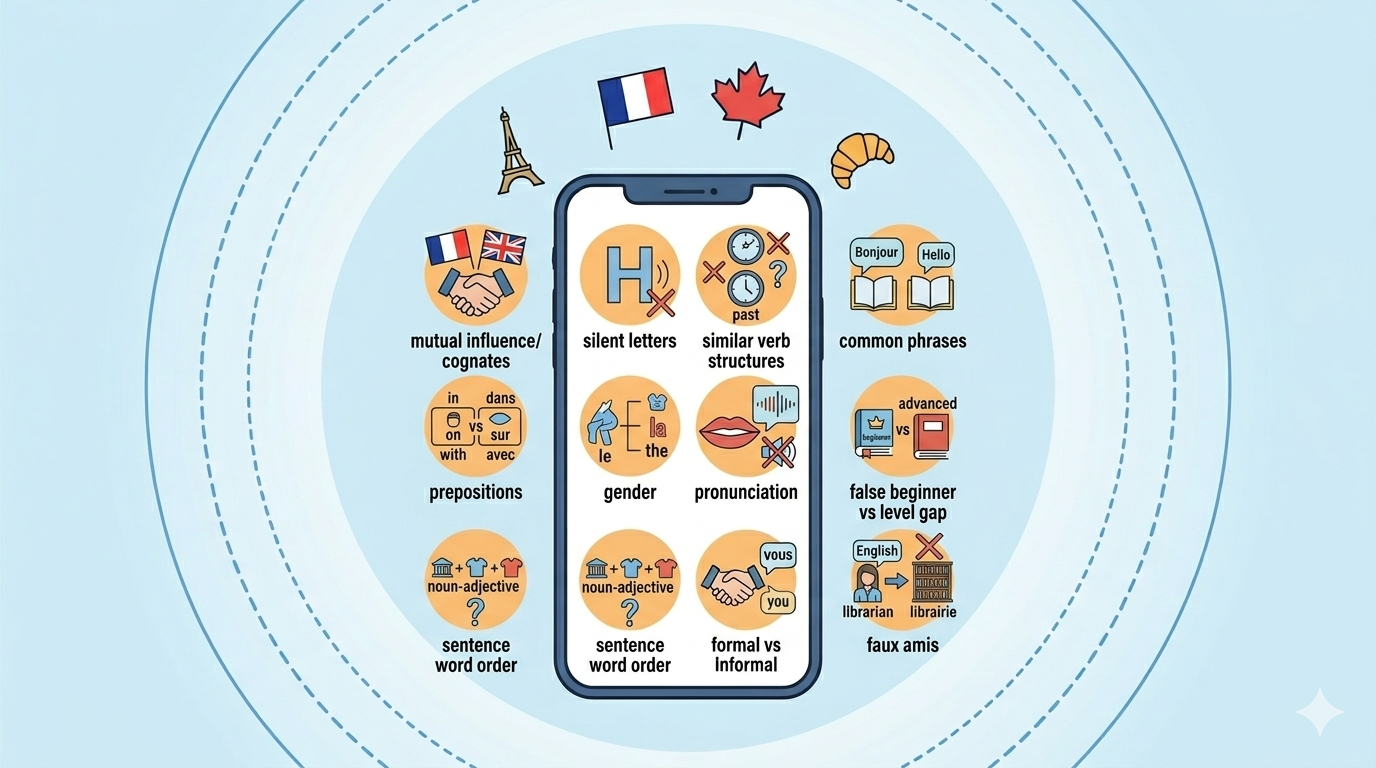
    Learning French can feel much easier once you understand how closely connected English and French actually are. These two languages share centuries of historical interaction, thousands of similar words, and many cultural influences. At the same time, they differ in grammar, pronunciation, and communication style.

    For English speakers, recognizing these similarities and differences is one of the most powerful ways to accelerate language progress. In this comprehensive guide, we will explore how English and French evolved together, where they overlap, and where learners must adapt their thinking to truly master French.

    If you are starting your language journey, structured programs such as those available through PrepFrench Classes can help you understand these patterns more quickly and avoid common beginner mistakes.

    Tip: Understanding how English and French connect historically can significantly simplify vocabulary learning. Many words already exist in both languages with similar meanings.

    Table of Contents

    • Historical Connections Between English and French
    • Vocabulary Similarities and Cognates
    • Major Grammar Differences
    • Pronunciation Differences
    • Cultural Influences in Language
    • Practical Tips for English Speakers Learning French
    • FAQ

    Historical Connections Between English and French

    Understanding the historical relationship between English and French provides valuable insight when learning French. One of the most influential events shaping both languages was the Norman Conquest of England in 1066.

    After the conquest, French became the language of the English aristocracy and administration for several centuries. As a result, thousands of French words entered English vocabulary.

    Today, linguists estimate that roughly 30% of English vocabulary originates from French. Words related to law, governance, cuisine, and art frequently come from French origins.

    For deeper linguistic research on language development and frameworks, you can explore resources from the official CEFR language framework.

    During the Renaissance and later global expansion, English also influenced French in return. This mutual exchange means modern learners often recognize familiar patterns across both languages.

    Want Structured Guidance for Learning French?

    Our instructors help students understand grammar, vocabulary, and pronunciation step-by-step.

    Book Free Demo

    Explore Courses

    Vocabulary Similarities That Make Learning French Easier

    One of the biggest advantages English speakers have when learning French is the presence of cognates. Cognates are words that look similar and share similar meanings in both languages.

    Examples include:

    English French Meaning
    Restaurant Restaurant Dining place
    Artist Artiste Creative professional
    Justice Justice Legal fairness
    Culture Culture Societal traditions

    These shared words help learners quickly build vocabulary confidence. However, it is important to watch for false friends — words that appear similar but carry different meanings.

    For example:

    • Actuellement means “currently”, not “actually”.
    • Library translates to bibliothèque, not librairie.

    Understanding these distinctions is essential for effective communication while learning French.

    Grammar Differences Between English and French

    Despite vocabulary similarities, grammar differences can challenge English speakers when learning French. These differences require careful practice and exposure.

    Gendered Nouns

    Unlike English, French nouns are assigned grammatical gender.

    Examples:

    • le livre (the book – masculine)
    • la table (the table – feminine)

    Adjectives and articles must agree with the noun’s gender, which adds an extra layer of complexity.

    Verb Conjugation

    French verbs change depending on the subject and tense. For example:

    • Je parle
    • Tu parles
    • Nous parlons

    English verbs change less frequently, which is why conjugation may feel unfamiliar to new learners.

    Official explanations of language proficiency standards can be explored through resources such as France Éducation International.

    Study Tip: Instead of memorizing grammar tables alone, practice using verbs in real sentences and conversations.

    Pronunciation Differences When Learning French

    Pronunciation is one of the biggest hurdles when learning French. French includes several sounds that do not exist in English.

    Common pronunciation challenges include:

    • Nasal vowels (an, on, in)
    • The French “r” sound
    • Silent final consonants
    • Liaison between words

    Listening practice is essential. Educational research published through organizations such as OECD education studies emphasizes the importance of audio exposure when acquiring new languages.

    Consistent listening to native speech gradually trains your ear to identify these subtle sound differences.

    Improve Your Pronunciation with Expert Guidance

    Practice speaking with instructors who correct pronunciation and build confidence.

    Book Free Demo

    TCF Preparation | TEF Preparation

    Cultural Differences Reflected in Language

    Language reflects cultural values. When learning French, understanding cultural norms can help you communicate more naturally.

    One important example is the distinction between:

    • Tu – informal “you”
    • Vous – formal or plural “you”

    Using the wrong form can sometimes sound impolite. French culture tends to place strong emphasis on politeness and formality.

    Global cultural research conducted by institutions such as UNESCO cultural initiatives highlights how language structures often mirror societal values.

    By understanding cultural context, learners develop not only linguistic accuracy but also social awareness.

    Practical Tips for English Speakers Learning French

    To accelerate progress while learning French, consider these proven strategies:

    • Practice speaking daily
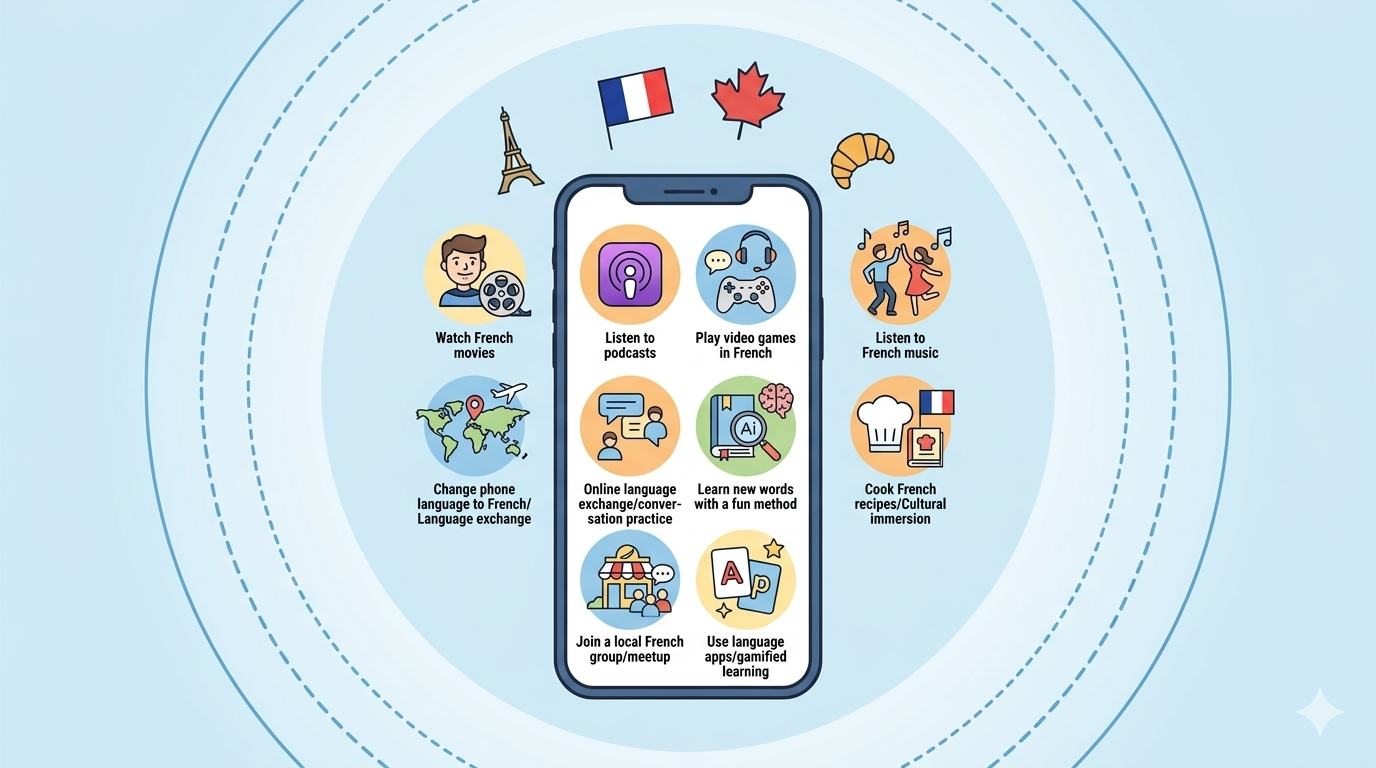
    • Watch French films or listen to podcasts
    • Learn phrases instead of isolated words
    • Review vocabulary consistently
    • Join structured language classes

    If your goal includes official certification or immigration pathways, structured preparation programs can significantly improve success rates.

    Explore training options through professional language programs designed for beginners and advanced learners.

    Conclusion

    Understanding the similarities and differences between English and French provides a powerful advantage when learning French. Shared vocabulary makes the language accessible, while grammar and pronunciation differences present stimulating challenges.

    With consistent practice, cultural awareness, and the right learning environment, English speakers can achieve fluency far more efficiently than they might expect.

    The key is to stay curious, practice regularly, and embrace both the similarities and the differences that make the French language so fascinating.

    Start Your French Learning Journey Today

    Join live online classes, structured lessons, and expert guidance.

    Book Free Demo

    Frequently Asked Questions

    What makes French easier for English speakers?

    Thousands of shared vocabulary words and historical connections make French more accessible to English speakers than many other languages.

    What is the biggest grammar difference between English and French?

    The system of gendered nouns and verb conjugations are two of the biggest grammar differences.

    Is French pronunciation difficult?

    French pronunciation includes nasal vowels and silent letters that require practice but become easier with listening exposure.

    How long does it take to learn French?

    With consistent study and practice, conversational proficiency often develops within 12–24 months.

    Can I learn French online?

    Yes. Online classes, speaking practice, and multimedia resources allow learners to develop strong language skills from anywhere.
  • 10 Creative and Effective Ways to Learn French

    10 Creative and Effective Ways to Learn French

    Learning French can feel like a maze—grammar rules, vocabulary, pronunciation, and cultural nuance all connected. But here’s the secret: French becomes easier when it becomes part of your life.

    This guide shares 10 creative and practical ways to learn French in 2026—whether you’re a complete beginner, returning learner, or preparing for an exam. You’ll also see how PrepFrench Classes helps learners stay consistent through structured pathways, live practice, and real feedback.

    Want a personalized plan instead of random tips?

    Book a FREE demo class / consultation and we’ll map your next 30 days of French based on your level and goal.

    Book Free Demo    Explore Courses

    Method #1: Immersion at Home (No Travel Needed)

    Immersion means surrounding yourself with French so your brain starts recognizing patterns naturally. You don’t need to live in France—you can build a “French environment” at home.

    How to do it (10–30 minutes/day):

    • Switch your phone interface and favorite apps to French (start with small ones first).
    • Label household items in French (frigo, miroir, fenêtre, chargeur…).
    • Create a “French time” block: 15 minutes where you only read/listen/speak French.
    • Use French in micro-moments: counting, time, weather, grocery list, reminders.

    External resources: TV5MONDE offers free French learning exercises and videos across levels (A1–B2): Apprendre.TV5MONDE.

    Mini challenge: For 7 days, do one daily task in French (to-do list, shopping list, calendar note, or voice note).

    Method #2: Use Apps Strategically (Not Randomly)

    Apps are excellent for building consistency—if you use them with a clear purpose. The goal is not “finish the app,” it’s “build repeatable habits.”

    Best app approach:

    • 5–10 minutes/day for vocabulary and repetition.
    • 2–3 times/week for listening/speaking practice.
    • Write down 10 useful phrases/week and use them in sentences.

    Popular French apps (official pages):

    Pro tip: Don’t add 5 apps. Pick 1 app + 1 speaking habit + 1 writing habit. That combo beats app-hopping every time.

    Method #3: Speak from Day One (Even with Simple Sentences)

    Speaking is the skill most learners delay—and that delay is exactly why they feel “stuck.” You don’t need perfect grammar to start speaking. You need repeatable sentence patterns and a safe place to practice.

    Beginner speaking formula:

    • Je m’appelle… (My name is…)
    • J’habite à… (I live in…)
    • J’aime / Je n’aime pas… (I like / don’t like…)
    • Aujourd’hui, je vais… (Today, I’m going to…)
    • Je voudrais… (I would like…)

    Practice ideas:

    • Record 30–60 second voice notes daily and listen back.
    • Shadow audio: repeat a sentence immediately after a native speaker.
    • Do “mirror speaking”: 2 minutes in front of a mirror, no stopping.

    Want guided speaking feedback and confidence building? Explore live learning at PrepFrench Classes.

    Method #4: Learn Through Films & Series (Smart Subtitle Strategy)

    Watching content in French helps you absorb pronunciation, rhythm, and real expressions. But subtitles matter: if you use English subtitles forever, your brain stays in English.

    The best subtitle progression:

    1. French audio + English subtitles (week 1–2 for comfort)
    2. French audio + French subtitles (week 2–6 for learning)
    3. French audio only (short scenes, repeated)

    What to do while watching (simple but powerful):

    • Pause and write 3 new phrases per episode.
    • Repeat 1 scene aloud (shadowing) until it feels natural.
    • Notice common connectors: donc, pourtant, en fait, du coup, parce que.

    For video-based French learning exercises, TV5MONDE’s learning platform is excellent: Apprendre.TV5MONDE.

    Method #5: Join a French Learning Community (Online or Local)

    Community is underrated. When you have people around you learning the same language, you stay consistent longer. You also get real-world conversation practice, which accelerates fluency.

    Best ways to find speaking partners:

    • Language exchange apps like Tandem and HelloTalk.
    • Local meetups, cultural events, or French clubs (where available).
    • Online groups for French learners (Discord, Facebook groups, etc.).

    Mini challenge: Do 1 short call per week. Start with: 10 minutes, 3 questions, 3 answers. Repeat weekly.

    PrepFrench also supports structured learning + guided practice. Explore: All Courses

    Method #6: French Journaling (Micro-Writing That Builds Fluency)

    Writing forces clarity. Even 5 minutes of daily writing improves grammar accuracy and vocabulary recall. The trick is to keep it short and repeatable.

    Three journaling formats that work:

    • 3 sentences/day: “Today I did…, I feel…, Tomorrow I will…”
    • One paragraph/week: a mini story or opinion
    • Message practice: pretend you’re texting a friend in French

    Useful sentence starters:

    • Aujourd’hui,
    • Je pense que
    • J’aimerais
    • Ce qui est difficile, c’est

    Want correction feedback (the fastest way to improve writing)? Book a free demo: Contact PrepFrench.

    Method #7: Spaced Repetition Flashcards (The Memory Shortcut)

    Most learners “forget vocabulary” because they don’t review it properly. Spaced repetition solves that by showing you words at the right time—before you forget them.

    How to do it:

    • Add only 10–15 new words/week (quality > quantity).
    • Store them in phrases, not alone (example sentence included).
    • Review for 5 minutes/day.
    • Once a week, speak using 10 flashcard words in a short story.

    Pro tip: Make “confusion cards” for tricky pairs (a/à, son/sont, ou/où). These errors vanish when you review them properly.

    Method #8: Learn French Through Food, Recipes & Daily Life

    Daily-life French sticks because you use it often. Food is one of the easiest “real-world” themes to practice at any level.

    Easy ways to learn through food:

    • Read 1 recipe/week in French and highlight 10 words.
    • Watch French cooking videos and repeat 5 phrases.
    • Practice ordering dialogues: restaurant / café / bakery.
    • Learn everyday kitchen words: poêle, casserole, farine, couper, mélanger, cuire.

    Bonus: when you learn vocabulary in context, your brain connects it to actions—so it stays longer.

    Method #9: Roleplay & Real-World Simulations (Fast Confidence Builder)

    Roleplay is one of the fastest ways to become conversational. Why? Because it trains your brain to respond in real time. You practice what you’ll actually say in real situations.

    Roleplay scenarios (choose one per week):

    • Booking an appointment
    • Asking for directions
    • Introducing yourself at a party
    • Ordering food & asking preferences
    • Job interview basics (B1+)
    • Explaining your daily routine

    Mini challenge: Write a 10-line script for one scenario and practice it aloud until it’s smooth. Then change 3 details and repeat.

    Method #10: Goal-Based Tracking + Mock Tests (The “Serious Progress” System)

    If you want faster progress, you need measurement. Not obsession—just visibility. Track your habits and do small checkpoints so you know what’s improving.

    What to track weekly:

    • Minutes listened
    • New words used in sentences
    • Speaking minutes
    • Writing tasks completed
    • One “win” and one “fix”

    Mock testing idea: Every 2 weeks, do a mini mock:

    • Listening: 10 minutes
    • Reading: 10 minutes
    • Writing: 1 short task
    • Speaking: 2-minute voice note

    If your goal is Canadian immigration exams, structured prep matters: Full TCF Canada (CLB 7) | Full TEF Canada (CLB 7)

    A Simple 7-Day French Plan (Beginner-Friendly)

    Here’s a realistic weekly structure you can repeat every week:

    Day Focus Task (30–60 min total)
    Mon Listening + vocab 10 min audio + 10 words + 5 sentences
    Tue Grammar + speaking 1 grammar topic + 5 min voice note
    Wed Reading Short article + highlight 10 phrases
    Thu Writing 3-sentence journal + correct it
    Fri Film/series 1 scene + shadowing + 5 phrases
    Sat Conversation 10–20 min language exchange
    Sun Review Review cards + 2-min speaking recap

    Want Faster Progress Than Self-Study?

    Apps and tips help—but the fastest progress comes from structured lessons + speaking practice + feedback. Book a FREE demo and we’ll build your personalized plan.

    👉 Book Free Demo / Consultation

    Explore: All Courses  |  Home

    Frequently Asked Questions

    How long does it take to learn French effectively?

    It depends on your consistency, your target (conversation vs exam), and how much speaking practice you do. Most learners see strong progress within a few months when they follow a structured plan consistently.

    What are the best online resources for French conversation?

    Great options include language exchange apps like Tandem and HelloTalk, and structured classes where you get live feedback. PrepFrench Classes also provides guided speaking practice aligned with your level.

  • Debunking the Myths: 10 Misconceptions About French Culture and People

    Debunking the Myths: 10 Misconceptions About French Culture and People

    Understanding French culture is essential for building meaningful communication, especially if you are learning French for travel, study, work, or immigration. Yet many people approach France with stereotypes that can create misunderstandings before the conversation even starts.

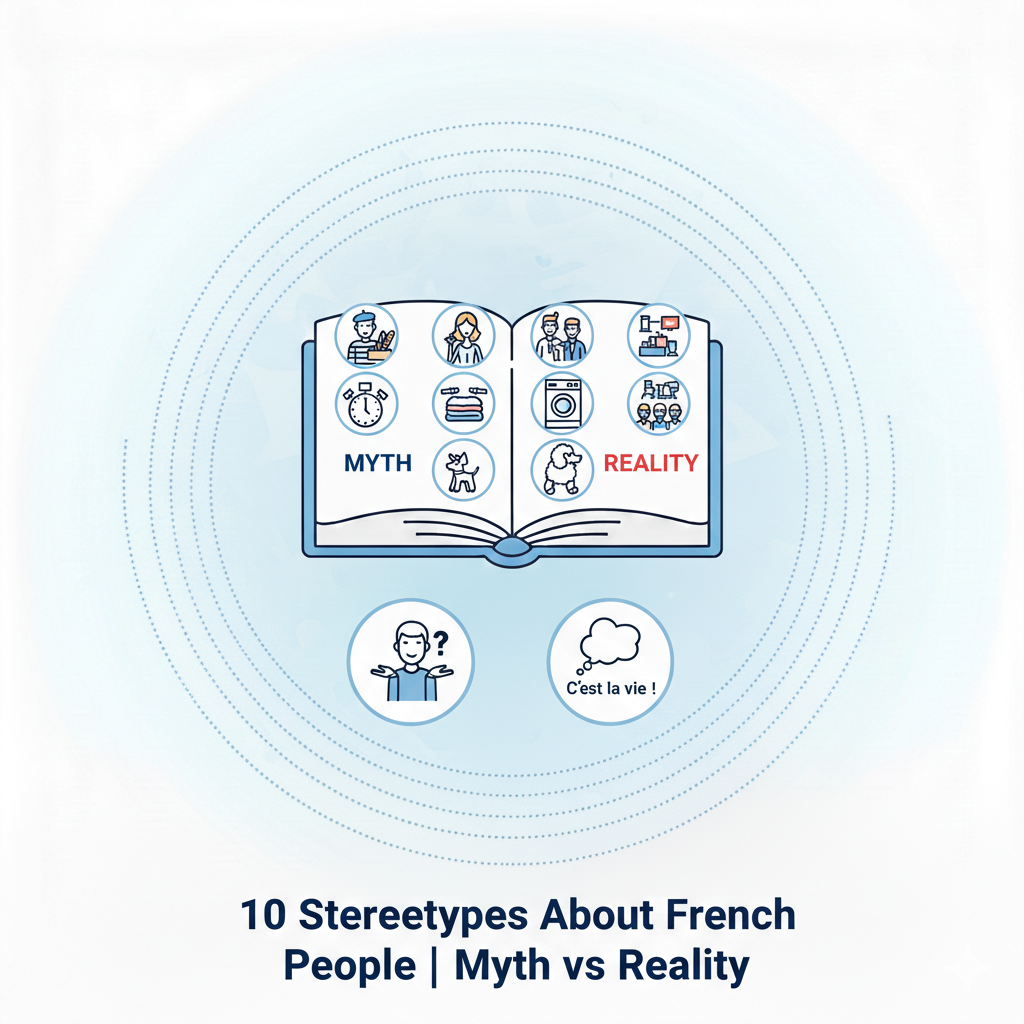
    In this guide, we break down 10 common myths about French culture and people, explain where they come from, and replace them with a more accurate, practical perspective. If you are learning French, this will also help you communicate more naturally and respectfully in real situations.

    Why Stereotypes About French Culture Exist

    Stereotypes usually come from partial experiences, media portrayals, social media clips, or isolated travel moments that get generalized into “truths.” A tourist may have one rushed interaction in a busy city and assume it represents the entire country. In reality, France is a large and regionally diverse nation with different communication styles, habits, and social expectations.

    Another reason stereotypes persist is that cultural norms are often misunderstood. For example, what feels “cold” in one culture may simply be “formal” in another. Similarly, what seems overly direct to one person may be normal politeness elsewhere.

    If you are learning French, understanding these differences is not just interesting, it is practical. It helps you interpret tone, body language, etiquette, humor, and context more accurately. That is one reason learners at PrepFrench Classes benefit from a learning approach that combines language skills with cultural understanding.

    Myth #1: All French People Are Rude

    Reality: French politeness often follows different rules

    This is probably the most common stereotype, and it is also one of the most misleading. In many cases, what visitors interpret as rudeness is actually a mismatch in etiquette expectations. In France, greeting someone properly matters a lot. Entering a shop and immediately asking a question without saying Bonjour can come across as abrupt.

    French social etiquette often places importance on formal greetings, respectful tone, and context. In busy cities, people may be efficient or reserved, but that does not automatically mean they are unfriendly. In smaller towns or with a polite opening in French, people can be extremely warm and helpful.

    Practical tip for learners and travelers: Start with simple phrases like “Bonjour,” “Bonsoir,” “S’il vous plaît,” and “Merci.” These small habits can dramatically improve the quality of your interactions.

    At PrepFrench, beginner students practice these everyday social phrases early so they can navigate real-life situations more smoothly. If you are just starting out, explore our French course options and choose a level that fits your goals.

    Myth #2: French Cuisine = Baguettes and Croissants

    Reality: French cuisine is deeply regional and incredibly diverse

    Baguettes and croissants are iconic, yes, but they represent only a tiny portion of French food culture. One of the biggest mistakes people make is treating “French cuisine” as one single style. In reality, food traditions vary widely by region, climate, and local ingredients.

    For example, coastal regions may emphasize seafood, while inland regions may focus on slow-cooked dishes, cheese traditions, and seasonal produce. You will also find strong regional identities in sauces, breads, pastries, desserts, and cooking techniques. This diversity is one reason French food culture is admired worldwide.

    If you are learning French, food vocabulary is a fun and practical gateway into culture. Menu words, ingredients, dining etiquette, and expressions used in cafés can all improve both your comprehension and confidence.

    In our classes, we often use themed vocabulary (food, travel, shopping, daily life) to make learning more memorable and useful in real contexts.

    Myth #3: French People Are Obsessed with Wine and Cheese

    Reality: Wine and cheese are part of culture, not the whole culture

    This stereotype takes two important parts of French gastronomy and exaggerates them into a caricature. Yes, wine and cheese are culturally significant in many parts of France. However, everyday life in France includes a much broader approach to food centered around balance, variety, routine, and meal structure.

    French eating habits often emphasize quality over excess, seasonal ingredients, and shared meals. Wine and cheese may appear in certain meals, social gatherings, or special occasions, but they do not define every person’s diet or lifestyle. Just like anywhere else, habits vary by age, region, health goals, family background, and personal preference.

    For language learners, this myth is a good reminder that vocabulary should extend beyond tourist clichés. Learning how to discuss vegetables, markets, meal routines, allergies, preferences, and cooking methods gives you much more useful conversational French.

    Myth #4: Every French Person Is a Fashion Icon

    Reality: French style is diverse, personal, and influenced by region and lifestyle

    France, especially Paris, has a global reputation for fashion. That reputation is real, but the stereotype becomes misleading when people assume every person in France dresses like a runway model.

    French fashion culture includes everything from luxury and haute couture to minimal everyday dressing, practical workwear, student style, streetwear, and regional preferences. A person living in a small town, a student in Lyon, and a professional in Paris may all have completely different styles.

    The idea of “effortless French style” is often more about fit, simplicity, and confidence than expensive clothing. Many French people prioritize practicality and personal expression, just like people everywhere else.

    For learners, fashion can be a helpful theme for adjectives, colors, opinions, and shopping dialogues. It also helps you understand how people describe taste and identity in French conversations.

    Myth #5: French People Are Super Serious

    Reality: French culture includes plenty of humor, playfulness, and wordplay

    Another common misconception is that French people are always formal, intense, or emotionally distant. In truth, humor is a big part of French social life. The style of humor may simply be different from what some learners expect.

    French humor often includes irony, subtle sarcasm, wit, and wordplay. In casual settings, friends may tease each other, joke creatively, or use expressions that do not translate directly into English. If you are learning French, some jokes may initially feel difficult to catch because they rely on vocabulary, tone, and cultural references.

    This is why cultural context matters so much. When learners improve their listening and idiomatic understanding, conversations begin to feel more natural and enjoyable.

    At PrepFrench, we encourage students to learn not just textbook French, but also real conversational patterns that help them understand humor, warmth, and social nuance.

    Myth #6: France Is Basically Just Paris

    Reality: France has strong regional identities, accents, traditions, and lifestyles

    Paris is globally influential, but it is not a complete representation of France. One of the most important truths about French culture is its regional diversity. From the north to the Mediterranean coast, from mountain communities to Atlantic cities, local traditions shape food, speech, social habits, and even rhythms of daily life.

    Travelers and learners who only compare France to Paris often miss this diversity. Communication styles, pace, and social expectations can differ from region to region. A warm, expressive interaction in one area may feel very different from a fast-paced urban exchange in another.

    This matters for language learners because “real French” is not just one accent or one social setting. Exposure to variation helps build stronger listening comprehension and adaptability.

    Myth #7: Everyone in France Speaks the Same French

    Reality: Accent, register, and regional linguistic diversity are very real

    Many beginners imagine that there is one standard French spoken the same way by everyone. While standard French exists and is taught in schools, the reality is more layered. France includes regional accents, local expressions, and different speaking registers depending on age, context, and social environment.

    In addition, France has a rich linguistic landscape shaped by regional languages and historical influences. This does not mean a beginner needs to learn everything at once, but it does mean learners should expect variation and not panic when pronunciation or wording changes slightly.

    A strong learning program helps students first build a clear foundation, then gradually understand variation through listening practice, conversation exposure, and real-world examples.

    Myth #8: French People Hate Speaking English or Talking to Foreigners

    Reality: Most interactions improve when you show respect and make an effort

    This stereotype usually comes from awkward travel moments. In reality, many French people are willing to help, especially when visitors begin respectfully and make some effort in French. Even a simple opening like “Bonjour, parlez-vous anglais?” shows courtesy and usually leads to a better response.

    Sometimes the issue is not hostility, but comfort level. A person may not feel confident speaking English, may be busy, or may prefer that you begin with a greeting. Also, communication breakdowns happen in every country, not just France.

    The best approach is simple:

    • Start with a greeting
    • Speak politely and clearly
    • Use basic French if possible
    • Do not assume tone means hostility

    If your goal is to travel or settle in a French-speaking environment, learning everyday polite expressions can make a huge difference in your confidence and real-world experience.

    Myth #9: French People Do Not Work Hard (They Are Always on Vacation or Strike)

    Reality: France values work-life balance, and public debate is highly visible

    This myth often spreads because visible protests and labor discussions in France receive international attention. But being vocal about labor rights or public policy is not the same as lacking discipline or work ethic.

    In France, work-life balance is a major social value, and public participation in civic issues can be more visible than in some other countries. That can create an outsider perception that people are “always off” or “not working,” when the reality is far more complex.

    In fact, many professionals, entrepreneurs, public servants, and students in France work in demanding environments. The stronger emphasis on personal time, meals, family life, and labor protections reflects a social model, not laziness.

    For language learners, understanding this distinction helps avoid judgment-based conversations and supports more respectful cultural discussions.

    Myth #10: French Culture Is Old-Fashioned and Not Diverse

    Reality: French culture is both deeply rooted and constantly evolving

    Some people imagine French culture as frozen in time, centered only on old monuments, classical art, and historical traditions. While France is famous for its heritage, modern France is also shaped by contemporary music, design, film, technology, food innovation, street culture, and global influences.

    French culture today is a dynamic mix of tradition and innovation. You can see this in cuisine, fashion, digital creativity, arts festivals, education, and the wide range of voices shaping public conversation. This is precisely why learning French opens so many doors. It gives you access to a living culture, not just a museum version of it.

    If you are learning French for your career, immigration, or academic growth, cultural understanding makes your language skills more effective. It helps you communicate with nuance, avoid stereotypes, and build better relationships.

    How Learning French Helps You Understand French Culture Better

    Language and culture cannot be separated. When you learn French, you do not just memorize verbs and vocabulary. You also learn:

    • How politeness works in real conversations
    • How tone changes meaning
    • How humor and idioms reflect cultural values
    • How regional differences shape communication
    • How to avoid misunderstandings while traveling or working

    Whether your goal is general fluency, travel confidence, or immigration preparation, structured training makes the process faster and more practical.

    If you are planning to learn French for Canada, explore our Full TCF Canada (CLB 7) course or Full TEF Canada (CLB 7) course. If you are still exploring options, visit our Courses page for all programs.

    Ready to Learn French the Right Way?

    Build real French skills with structured lessons, speaking practice, grammar support, and culture-focused learning. Ideal for beginners, exam learners, and immigration-focused students.

    Frequently Asked Questions

    1) What are the most common misconceptions about French people?

    Some of the most common misconceptions are that French people are rude, always serious, obsessed with wine and cheese, or all dress the same way. These stereotypes ignore regional diversity, individual personalities, and differences in etiquette across cultures.

    2) Why do people think the French are rude?

    Often, it comes from cultural misunderstanding. In France, greetings and polite openings matter a lot. If someone skips “Bonjour” and asks for something immediately, the interaction may feel awkward. Learning basic etiquette usually improves the experience significantly.

    3) How can learning French help me understand French culture better?

    Learning French helps you understand tone, expressions, humor, social norms, and context. This makes communication smoother and helps you connect more authentically with French-speaking people in travel, work, or study settings.

    4) Where can I start learning French with structured support?

    You can start by exploring the programs at PrepFrench Classes. If you want personalized guidance, book a free demo class here.

    Helpful External Resources

    These resources can help readers explore French culture, gastronomy, language diversity, fashion, and social context in more depth: