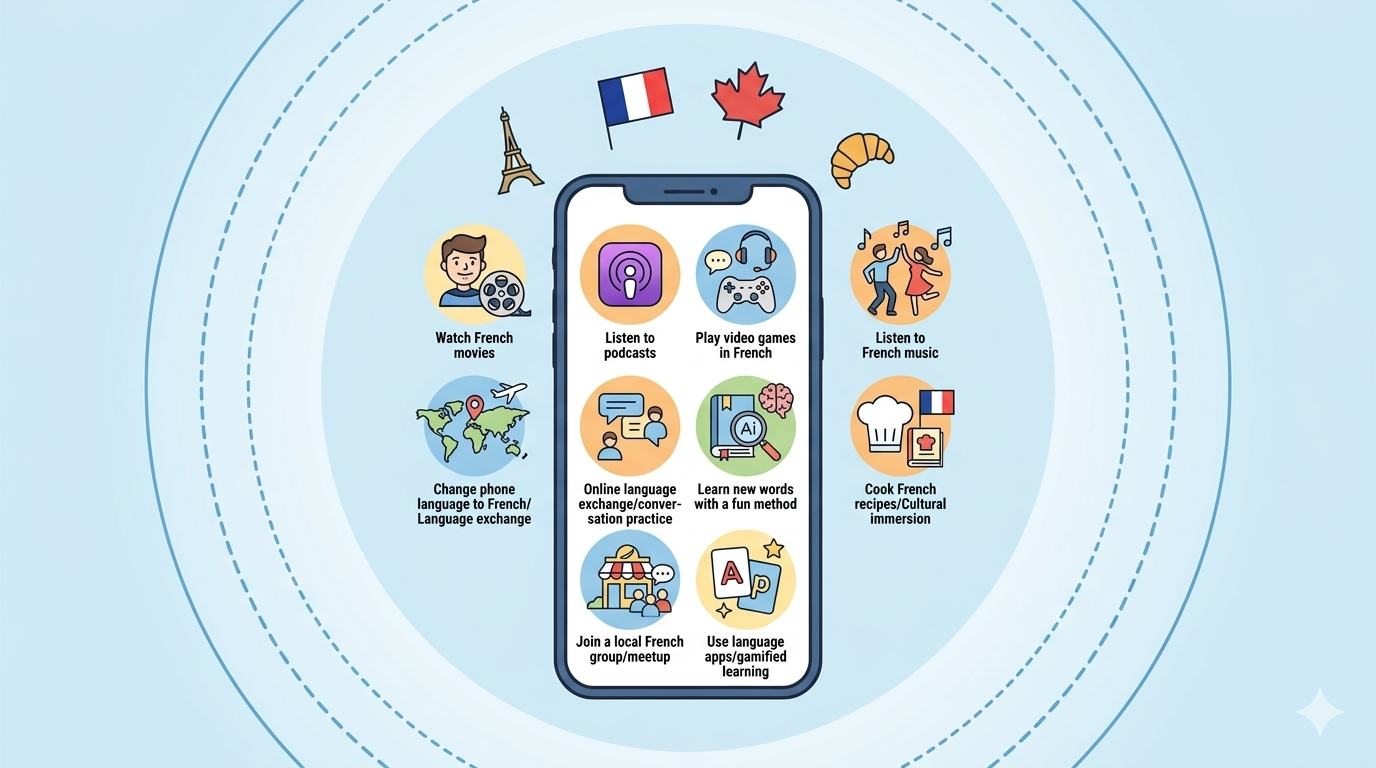
Learning French can feel like a maze—grammar rules, vocabulary, pronunciation, and cultural nuance all connected. But here’s the secret: French becomes easier when it becomes part of your life.
This guide shares 10 creative and practical ways to learn French in 2026—whether you’re a complete beginner, returning learner, or preparing for an exam. You’ll also see how PrepFrench Classes helps learners stay consistent through structured pathways, live practice, and real feedback.
Want a personalized plan instead of random tips?
Book a FREE demo class / consultation and we’ll map your next 30 days of French based on your level and goal.
Method #1: Immersion at Home (No Travel Needed)
Immersion means surrounding yourself with French so your brain starts recognizing patterns naturally. You don’t need to live in France—you can build a “French environment” at home.
How to do it (10–30 minutes/day):
- Switch your phone interface and favorite apps to French (start with small ones first).
- Label household items in French (frigo, miroir, fenêtre, chargeur…).
- Create a “French time” block: 15 minutes where you only read/listen/speak French.
- Use French in micro-moments: counting, time, weather, grocery list, reminders.
External resources: TV5MONDE offers free French learning exercises and videos across levels (A1–B2): Apprendre.TV5MONDE.
Mini challenge: For 7 days, do one daily task in French (to-do list, shopping list, calendar note, or voice note).
Method #2: Use Apps Strategically (Not Randomly)
Apps are excellent for building consistency—if you use them with a clear purpose. The goal is not “finish the app,” it’s “build repeatable habits.”
Best app approach:
- 5–10 minutes/day for vocabulary and repetition.
- 2–3 times/week for listening/speaking practice.
- Write down 10 useful phrases/week and use them in sentences.
Popular French apps (official pages):
Pro tip: Don’t add 5 apps. Pick 1 app + 1 speaking habit + 1 writing habit. That combo beats app-hopping every time.
Method #3: Speak from Day One (Even with Simple Sentences)
Speaking is the skill most learners delay—and that delay is exactly why they feel “stuck.” You don’t need perfect grammar to start speaking. You need repeatable sentence patterns and a safe place to practice.
Beginner speaking formula:
- Je m’appelle… (My name is…)
- J’habite à… (I live in…)
- J’aime / Je n’aime pas… (I like / don’t like…)
- Aujourd’hui, je vais… (Today, I’m going to…)
- Je voudrais… (I would like…)
Practice ideas:
- Record 30–60 second voice notes daily and listen back.
- Shadow audio: repeat a sentence immediately after a native speaker.
- Do “mirror speaking”: 2 minutes in front of a mirror, no stopping.
Want guided speaking feedback and confidence building? Explore live learning at PrepFrench Classes.
Method #4: Learn Through Films & Series (Smart Subtitle Strategy)
Watching content in French helps you absorb pronunciation, rhythm, and real expressions. But subtitles matter: if you use English subtitles forever, your brain stays in English.
The best subtitle progression:
- French audio + English subtitles (week 1–2 for comfort)
- French audio + French subtitles (week 2–6 for learning)
- French audio only (short scenes, repeated)
What to do while watching (simple but powerful):
- Pause and write 3 new phrases per episode.
- Repeat 1 scene aloud (shadowing) until it feels natural.
- Notice common connectors: donc, pourtant, en fait, du coup, parce que.
For video-based French learning exercises, TV5MONDE’s learning platform is excellent: Apprendre.TV5MONDE.
Method #5: Join a French Learning Community (Online or Local)
Community is underrated. When you have people around you learning the same language, you stay consistent longer. You also get real-world conversation practice, which accelerates fluency.
Best ways to find speaking partners:
- Language exchange apps like Tandem and HelloTalk.
- Local meetups, cultural events, or French clubs (where available).
- Online groups for French learners (Discord, Facebook groups, etc.).
Mini challenge: Do 1 short call per week. Start with: 10 minutes, 3 questions, 3 answers. Repeat weekly.
PrepFrench also supports structured learning + guided practice. Explore: All Courses
Method #6: French Journaling (Micro-Writing That Builds Fluency)
Writing forces clarity. Even 5 minutes of daily writing improves grammar accuracy and vocabulary recall. The trick is to keep it short and repeatable.
Three journaling formats that work:
- 3 sentences/day: “Today I did…, I feel…, Tomorrow I will…”
- One paragraph/week: a mini story or opinion
- Message practice: pretend you’re texting a friend in French
Useful sentence starters:
- Aujourd’hui, …
- Je pense que …
- J’aimerais …
- Ce qui est difficile, c’est …
Want correction feedback (the fastest way to improve writing)? Book a free demo: Contact PrepFrench.
Method #7: Spaced Repetition Flashcards (The Memory Shortcut)
Most learners “forget vocabulary” because they don’t review it properly. Spaced repetition solves that by showing you words at the right time—before you forget them.
How to do it:
- Add only 10–15 new words/week (quality > quantity).
- Store them in phrases, not alone (example sentence included).
- Review for 5 minutes/day.
- Once a week, speak using 10 flashcard words in a short story.
Pro tip: Make “confusion cards” for tricky pairs (a/à, son/sont, ou/où). These errors vanish when you review them properly.
Method #8: Learn French Through Food, Recipes & Daily Life
Daily-life French sticks because you use it often. Food is one of the easiest “real-world” themes to practice at any level.
Easy ways to learn through food:
- Read 1 recipe/week in French and highlight 10 words.
- Watch French cooking videos and repeat 5 phrases.
- Practice ordering dialogues: restaurant / café / bakery.
- Learn everyday kitchen words: poêle, casserole, farine, couper, mélanger, cuire.
Bonus: when you learn vocabulary in context, your brain connects it to actions—so it stays longer.
Method #9: Roleplay & Real-World Simulations (Fast Confidence Builder)
Roleplay is one of the fastest ways to become conversational. Why? Because it trains your brain to respond in real time. You practice what you’ll actually say in real situations.
Roleplay scenarios (choose one per week):
- Booking an appointment
- Asking for directions
- Introducing yourself at a party
- Ordering food & asking preferences
- Job interview basics (B1+)
- Explaining your daily routine
Mini challenge: Write a 10-line script for one scenario and practice it aloud until it’s smooth. Then change 3 details and repeat.
Method #10: Goal-Based Tracking + Mock Tests (The “Serious Progress” System)
If you want faster progress, you need measurement. Not obsession—just visibility. Track your habits and do small checkpoints so you know what’s improving.
What to track weekly:
- Minutes listened
- New words used in sentences
- Speaking minutes
- Writing tasks completed
- One “win” and one “fix”
Mock testing idea: Every 2 weeks, do a mini mock:
- Listening: 10 minutes
- Reading: 10 minutes
- Writing: 1 short task
- Speaking: 2-minute voice note
If your goal is Canadian immigration exams, structured prep matters: Full TCF Canada (CLB 7) | Full TEF Canada (CLB 7)
A Simple 7-Day French Plan (Beginner-Friendly)
Here’s a realistic weekly structure you can repeat every week:
| Day | Focus | Task (30–60 min total) |
|---|---|---|
| Mon | Listening + vocab | 10 min audio + 10 words + 5 sentences |
| Tue | Grammar + speaking | 1 grammar topic + 5 min voice note |
| Wed | Reading | Short article + highlight 10 phrases |
| Thu | Writing | 3-sentence journal + correct it |
| Fri | Film/series | 1 scene + shadowing + 5 phrases |
| Sat | Conversation | 10–20 min language exchange |
| Sun | Review | Review cards + 2-min speaking recap |
Want Faster Progress Than Self-Study?
Apps and tips help—but the fastest progress comes from structured lessons + speaking practice + feedback. Book a FREE demo and we’ll build your personalized plan.
👉 Book Free Demo / Consultation
Explore: All Courses | Home
Frequently Asked Questions
How long does it take to learn French effectively?
It depends on your consistency, your target (conversation vs exam), and how much speaking practice you do. Most learners see strong progress within a few months when they follow a structured plan consistently.
What are the best online resources for French conversation?
Great options include language exchange apps like Tandem and HelloTalk, and structured classes where you get live feedback. PrepFrench Classes also provides guided speaking practice aligned with your level.
Leave a Reply